


Introduction
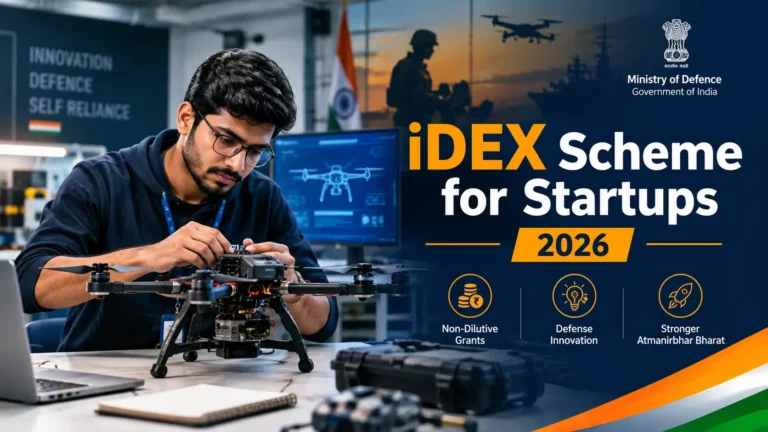
Most founders scanning India’s startup ecosystem for funding skip straight past government schemes — the paperwork and reputation scares them off before they even read the fine print. That’s a mistake if you’re building anything remotely dual-use: drones, sensors, secure comms, autonomous systems. For Indian founders building defense and dual-use technology, the iDEX scheme for startups offers a government-backed route to non-dilutive funding. Depending on the program and technology area, funding can range from standard DISC support to larger grants under iDEX Prime and ADITI.
The initiative, short for Innovations for Defence Excellence, is designed to help startups, MSMEs and eligible innovators develop technologies relevant to India’s defense needs.
iDEX (Innovations for Defence Excellence) is a Government of India scheme, run by the Ministry of Defence through the Defence Innovation Organisation (DIO), that gives non-dilutive grants to startups, MSMEs, and individual innovators building defense and dual-use technology. Since its 2018 launch, it has onboarded more than 676 startups, MSMEs, and individual innovators as of early 2026 — and the grant ceiling has climbed from ₹1.5 crore to as much as ₹25 crore under newer sub-programs.
If you’re an early founder, an indie hacker with a hardware itch, or a student trying to understand how India’s defense-tech boom actually gets funded, this guide walks through exactly how iDEX works, who qualifies, and where founders most often trip up.
What Is the iDEX Scheme?
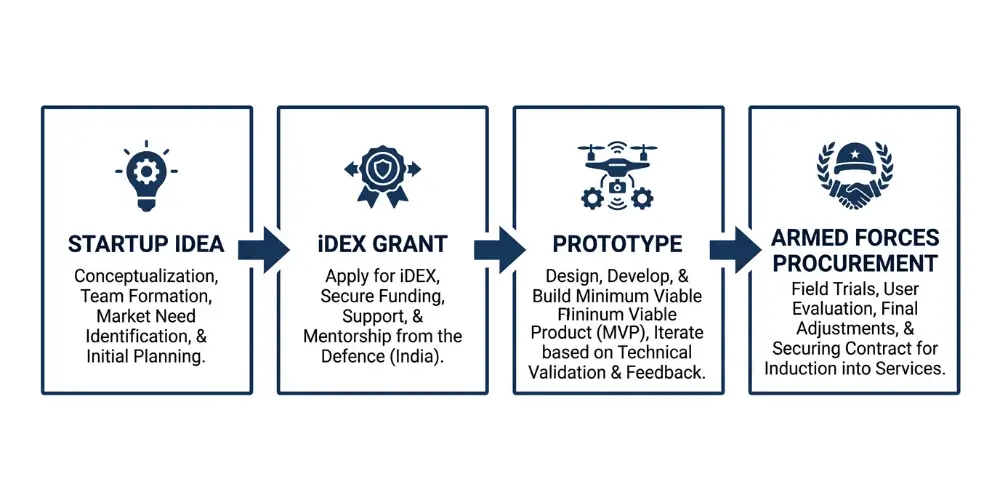
iDEX was launched in 2018 under the Ministry of Defence as a structural fix to a long-standing problem: India’s armed forces needed faster access to indigenous innovation, and the country’s startup ecosystem needed a credible non-dilutive funding path into a sector normally reserved for giant public-sector contractors. Before iDEX, a two-person startup with a working prototype had almost no route into defense procurement — the tendering process was built for companies with decades of compliance history, not fifteen-person teams working out of a co-working space.
The scheme sits inside a much bigger indigenization push — the same policy wave behind the Positive Indigenization Lists (which restrict imports of specified defense items to force domestic sourcing) and the dedicated Uttar Pradesh and Tamil Nadu Defense Corridors. If iDEX is where a startup gets its first grant and prototype validation, the Positive Indigenization List is often what turns that prototype into a guaranteed buyer later.
Key Facts About iDEX (2026)
| Fact | Detail |
| Launched | 2018, by the Ministry of Defence via the Defence Innovation Organisation (DIO) |
| Startups/innovators onboarded | 676+ as of February 2026 |
| Standard grant (SPARK/DISC) | Up to ₹1.5 crore |
| iDEX Prime grant | Up to ₹10 crore |
| ADITI grant (launched 2024) | Up to ₹25 crore, for 30 identified critical technologies |
| Equity taken | None — fully non-dilutive |
| IP ownership | Retained entirely by the startup |
| Defense budget context (2026) | Over ₹6 lakh crore (~$78 billion), a roughly 9.5% year-on-year increase |
| Related programs | Positive Indigenization Lists, UP & Tamil Nadu Defense Corridors, Technology Development Fund |
Who’s Eligible, and What Are the Grant Tiers?
iDEX funding isn’t a single flat grant — it’s a tiered structure, and knowing which tier fits your stage matters more than most applicants realize.
Eligible applicants generally include:
- Startups formally recognized by DPIIT under the Startup India initiative
- MSMEs registered in India
- Individual innovators (Indian citizens) with a working proof-of-concept relevant to a posted challenge
The three main funding tiers:
| Tier | Grant Ceiling | Best For |
| SPARK / DISC (Defence India Startup Challenge) | Up to ₹1.5 crore | Early prototype and proof-of-concept stage |
| iDEX Prime | Up to ₹10 crore | Mature startups moving from prototype to deployable product |
| ADITI | Up to ₹25 crore | Deep-tech teams building against 30 named critical technology areas (AI, quantum, anti-drone systems, adaptive camouflage, among others) |
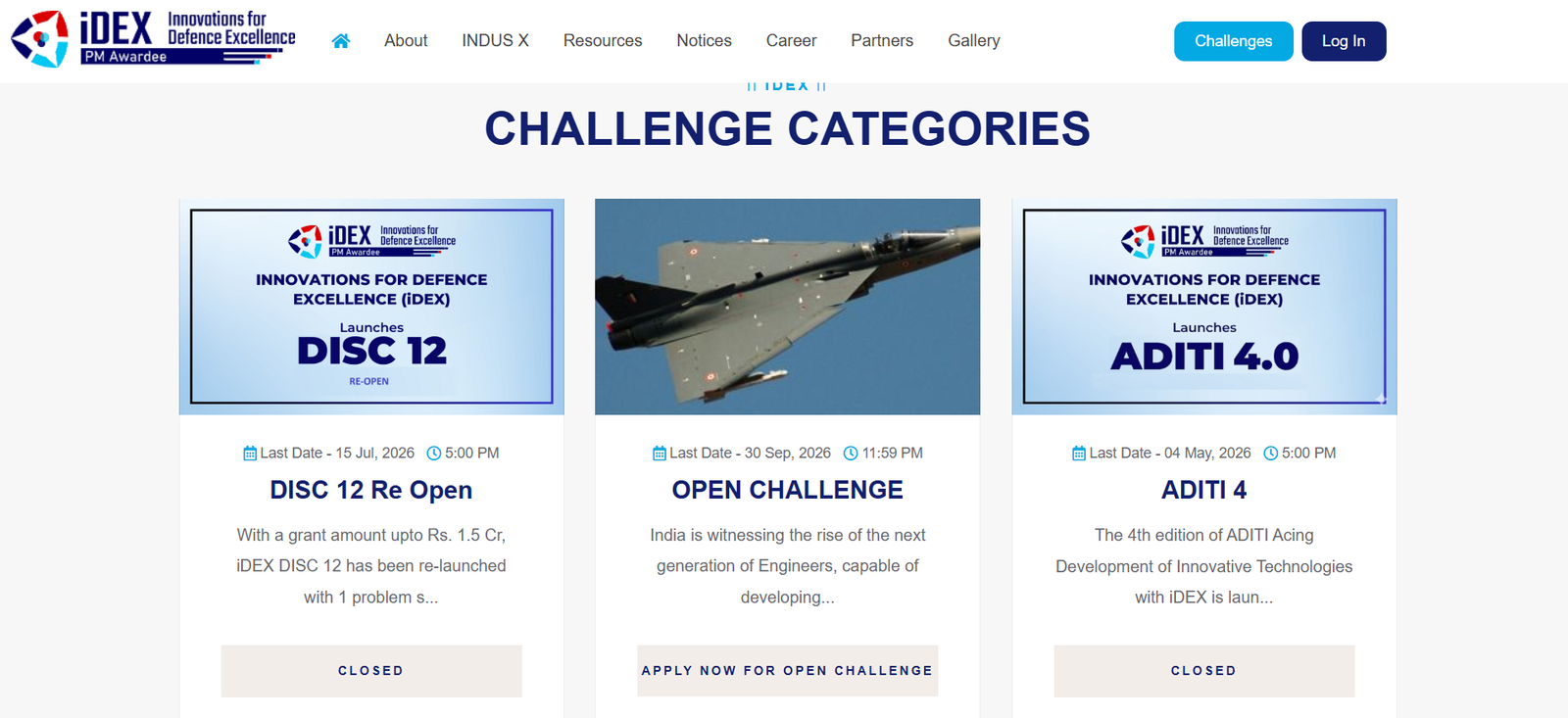
This is the detail most first-time applicants miss: you’re not pitching “your startup” in the abstract. You’re responding to a specific, published problem statement — a DISC challenge, an ADITI technology area, or an iDEX Prime call. The strongest applications read like a direct response to a client brief, not a research proposal.
How to Apply for an iDEX Grant
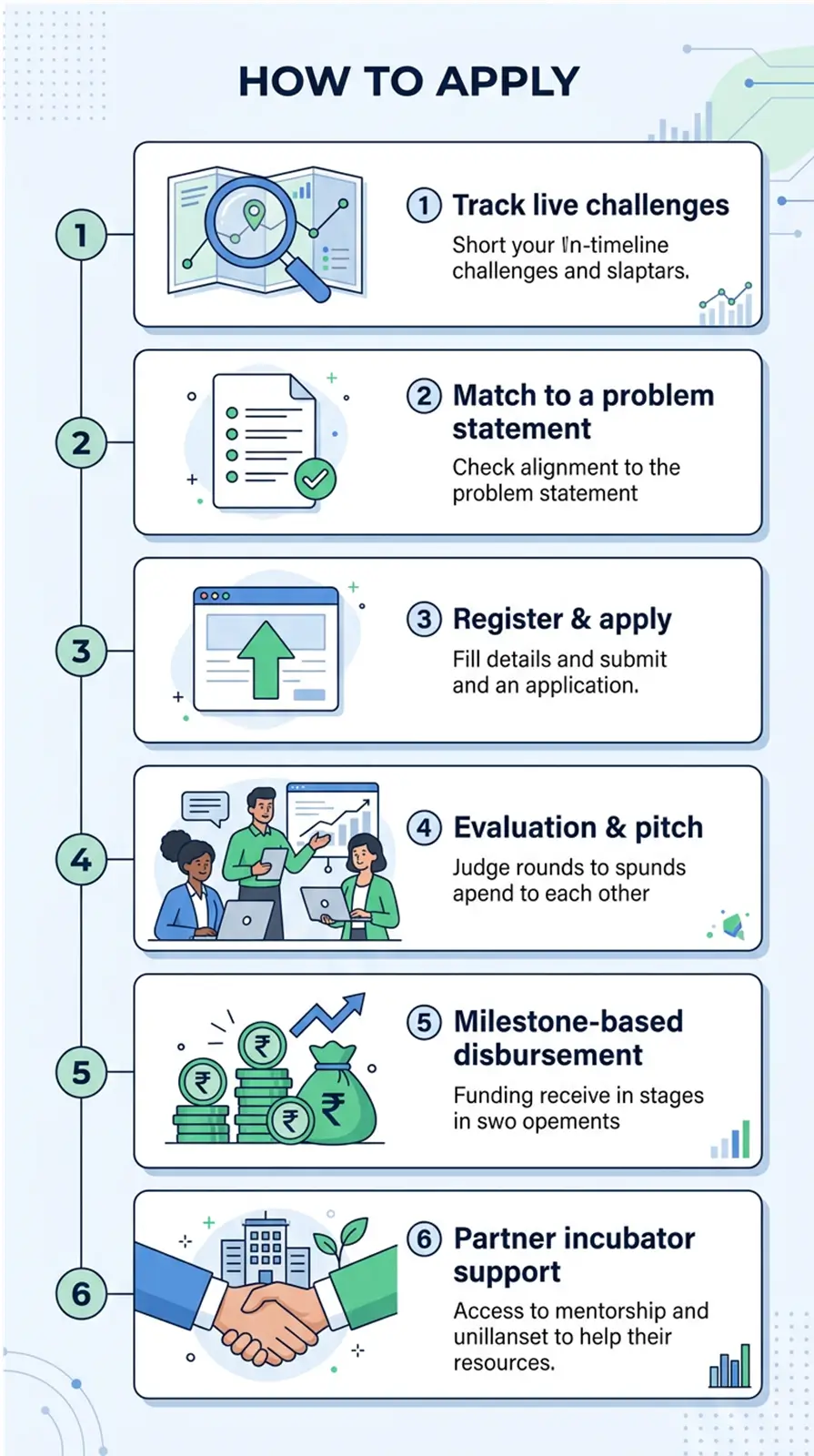
- Track live challenges on idex.gov.in — DISC, iDEX Prime, and ADITI challenges are posted on a rolling basis, each with its own problem statement and deadline.
- Match your technology to a specific problem statement. Generic applications rarely progress — evaluators are screening for direct fit, not general innovation.
- Register and apply through the official portal as a DPIIT-recognized startup, MSME, or individual innovator, submitting your proof-of-concept and technical documentation.
- Go through evaluation and pitch rounds, which typically include a technical screening followed by a presentation to a panel that includes armed forces representatives.
- Receive milestone-based disbursement — funding is usually released in tranches over roughly 18 months, tied to prototype development checkpoints rather than paid upfront in full.
- Work with a Partner Incubator, which provides mentorship, infrastructure access, and — in many cases — a fast-track relationship with procurement teams once your prototype is validated.
iDEX vs Technology Development Fund vs Private VC
| Dimension | iDEX (DISC/Prime/ADITI) | Technology Development Fund | Private VC Funding |
| Equity taken | None | None | Yes, typically 10–25%+ per round |
| Grant/investment size | ₹1.5–25 crore | Comparable, project-dependent | Highly variable |
| Speed to funding | Slow — months, tied to challenge cycles | Slow — similar government pace | Faster, but diligence-heavy |
| IP ownership | Retained by startup | Retained by startup | Retained by startup (until acquisition/IPO terms) |
| Best fit | Dual-use/defense-specific tech with a named problem statement | Broader defense R&D projects, often larger scale | Any sector, especially if you need speed or non-defense customers too |
The honest takeaway: iDEX isn’t a replacement for VC funding — it’s a parallel track. Many of the most credible Indian defense-tech startups run both simultaneously, using iDEX grants to fund deep R&D and prototyping while raising private capital for commercial scaling, hiring, and non-defense revenue lines.
Real Startups Built on iDEX Funding
A handful of now-recognizable names came up through this exact pipeline. Tonbo Imaging and ideaForge built early credibility partly through defense innovation challenges before becoming known names in imaging and drone manufacturing, respectively. Sagar Defence Engineering focused on unmanned aerial and marine systems — mine detection, coastal surveillance — a category almost impossible to fund through conventional VC alone given the long sales cycles involved. Newer entrants like NewSpace Research and Technologies, Garuda Aerospace, BonV Aero, and DroneAcharya reflect the same pattern: small teams, narrow technical focus, and a direct line to a government buyer that private markets alone rarely offer this early.
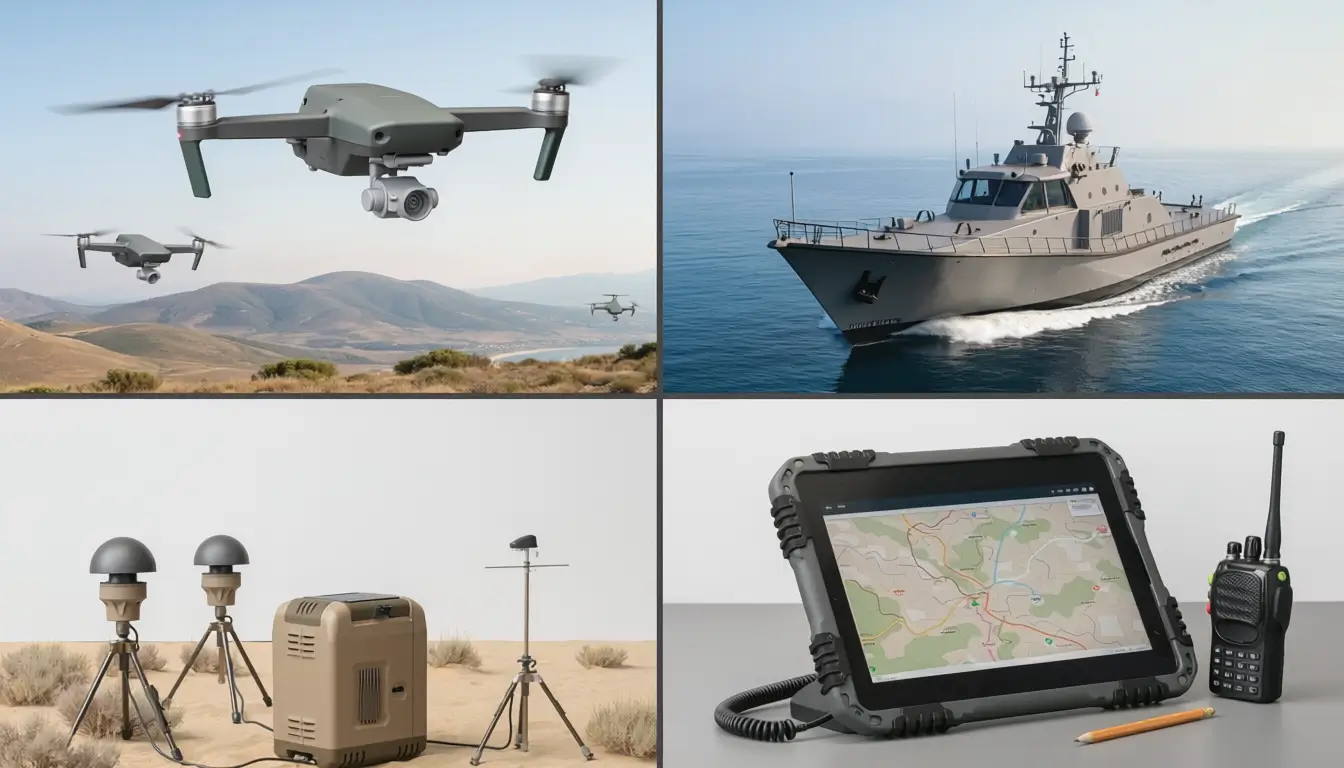
What connects these companies isn’t raw technical brilliance — plenty of well-funded startups have that. It’s narrow problem-fit. Each of them picked one specific operational gap the armed forces already knew they had, rather than building a broad platform and hoping the government would find a use for it.
Mistakes Founders Make When Applying
This is where most of the actual value in this guide lives, because almost nobody writes about it honestly.
- Pitching a platform instead of a problem-solution. Evaluators are screening for fit to a specific DISC or ADITI problem statement, not a broad vision.
- Underestimating the 18-month milestone cycle. Founders used to VC term sheets sometimes assume grant money arrives in one lump sum. It doesn’t — and cashflow planning around milestone-based disbursement is its own skill.
- Treating IP paperwork as an afterthought. Because iDEX doesn’t claim your IP, founders sometimes assume documentation doesn’t matter. It still does, especially once procurement conversations start.
- Ignoring the Partner Incubator relationship. The incubator isn’t a formality — it’s often the fastest route to getting your prototype in front of the right procurement officer.
- Assuming “government scheme” means “slow and low-value.” ₹25 crore under ADITI is a serious check by any Indian startup funding standard — the perception gap here is costing founders real opportunities.
My honest read, after digging through how these rounds actually get decided: the founders who win aren’t necessarily the most innovative on paper. They’re the ones who treat each posted challenge like a client brief and design their entire application around it — which is a very different skill from writing a compelling investor pitch deck.
Conclusion
The real story with iDEX isn’t “free government money exists” — plenty of founders already half-know that and dismiss it as too slow or too bureaucratic to bother with. The more useful insight is that India’s defense-tech funding gap is closing faster than founder awareness of it. Grant ceilings have grown roughly fifteen-fold since 2018 (from ₹1.5 crore to ₹25 crore under ADITI), and the bottleneck now isn’t capital availability — it’s founders knowing which problem statement to aim at, and building the discipline to survive an 18-month, milestone-based funding cycle instead of a single VC term sheet.
If you’re evaluating whether iDEX is worth your time, don’t start by refining your pitch deck. Start by reading the current live DISC and ADITI problem statements on idex.gov.in. The fastest way to get rejected isn’t a weak product — it’s applying to a challenge your technology was never actually built to solve.
Sources
- Department of Defence Production, Ministry of Defence — official iDEX scheme details (ddpmod.gov.in)
- idex.gov.in — live DISC, iDEX Prime, and ADITI challenge listings
- India Brand Equity Foundation (IBEF) — defense manufacturing industry report
- Drishti IAS — iDEX scheme policy explainer
- Global Venturing — Indian defense tech investment analysis
- Inkwood Research — Indian defense robotics market report
FAQ
What is the full form of iDEX? iDEX stands for Innovations for Defence Excellence, a Ministry of Defence scheme run through the Defence Innovation Organisation.
How much money can I actually get from iDEX? It depends on the tier: up to ₹1.5 crore under standard SPARK/DISC challenges, up to ₹10 crore under iDEX Prime, and up to ₹25 crore under the newer ADITI program for select critical technologies.
Can an individual apply, or do I need a registered company? Individual Indian citizen innovators can apply if they have a proof-of-concept relevant to a live challenge, though most later-stage tiers expect a DPIIT-recognized startup or MSME structure.
Does iDEX take equity or claim my IP? No. iDEX funding is fully non-dilutive, and startups retain complete ownership of their intellectual property.
How long does the process take, from application to funding? Timelines vary by challenge, but disbursement is milestone-based over roughly 18 months rather than paid as a lump sum upfront.
What’s the real difference between DISC, iDEX Prime, and ADITI? DISC challenges are typically earlier-stage and lower-ticket (up to ₹1.5 crore); iDEX Prime supports more mature prototypes at up to ₹10 crore; ADITI targets 30 named critical technology areas with grants up to ₹25 crore.
Do I need existing defense industry connections to apply? No — the entire point of iDEX is to open procurement access to teams without legacy defense contracting relationships. A strong technical fit to the posted problem statement matters more than pedigree.
Is iDEX only for drone and hardware startups? No. Listed technology areas span UAVs and counter-drone systems, AI-powered surveillance, electronic warfare, cybersecurity, advanced propulsion, and soldier modernization equipment — software and AI-first teams are very much in scope.


0 Comments