SevenFeeds Explained | We make complicated technology understandable
By Meenakshi, SevenFeeds
Published: August 12, 2026
Updated: August 31, 2026
Artificial intelligence is becoming part of everyday life, but there is a question that matters especially to a country as linguistically diverse as India:
Can AI understand the way Indians actually communicate?
India has 22 constitutionally recognised languages, hundreds of regional varieties and dialects, and a communication style that often mixes languages. A person may speak Hindi, use an English technical term in the same sentence, switch to a regional expression and then send the same question as a voice message.
Building AI for this environment requires more than simply translating an English-first model into Indian languages.
This is where BharatGen comes in.
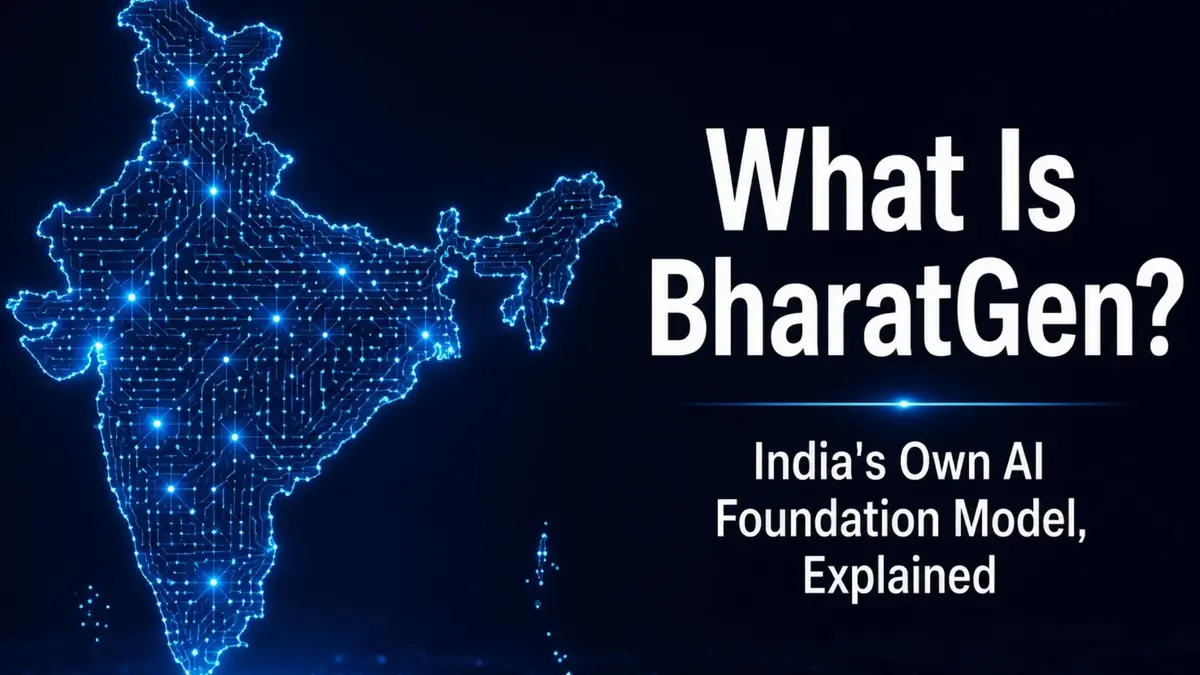
BharatGen is India’s sovereign AI initiative focused on developing multilingual and multimodal foundation models for Indian languages, data and use cases. The initiative brings together researchers and institutions to work on text, speech, vision and India-centric datasets.
But what exactly is BharatGen? Who is developing it? What is Param-1? How does BharatGen compare with general-purpose AI models? And what could it mean for Indian startups and businesses?
Let’s break it down in simple language.
What Is BharatGen and Why Does India Need It?
At its core, BharatGen is an effort to build AI with India in mind rather than treating Indian languages and contexts as an afterthought.
Many AI systems are developed using large datasets dominated by languages and cultural contexts from outside India. Indian users, however, often communicate differently.
Consider a simple example.
Someone might ask:
“Mujhe is document ka summary chahiye, but please explain it in simple Hindi.”
That single request combines Hindi and English. In another situation, the same person might speak the request instead of typing it.
For an AI system, understanding the words is only part of the challenge. It also needs to handle language switching, accents, regional variations, speech patterns and the context in which the information is being used.
BharatGen’s approach is built around this broader problem.
The initiative focuses on four major ideas:
- Multilingual AI: Models designed to work across Indian languages.
- Multimodal AI: AI that can work with different types of information, including text, speech and visual documents.
- India-centric data: Building and using datasets that better represent Indian languages, culture and contexts.
- An AI ecosystem: Providing models, research and tools that can support developers, researchers, startups and public-sector applications.
The Department of Science and Technology describes BharatGen as a government-supported initiative focused on foundational models in language, speech and computer vision.
BharatGen at a Glance
| Feature | What It Means |
|---|---|
| Main focus | Indian-language and India-focused AI |
| AI capabilities | Text, speech and vision |
| Lead institution | IIT Bombay |
| Government support | Department of Science and Technology and IndiaAI Mission |
| Key model | Param-1 |
| Param-1 size | 2.9 billion parameters |
| Broader ecosystem | Language, speech, vision, datasets and domain-specific models |
What Is a Foundation Model?
Before going further, it helps to understand one technical term: foundation model.
A foundation model is a large AI model trained on broad data that can serve as a base for different applications.
Think of it as an underlying engine.
A startup could potentially build a chatbot on top of a language model. Another organisation could build a document-processing application. A voice application could use speech models for recognition or generation.
The important point is that BharatGen is not simply trying to build one consumer chatbot.
It is developing a wider AI ecosystem involving models for:
- Text generation and understanding
- Speech recognition
- Text-to-speech
- Document and vision understanding
- Indian-language applications
- Domain-specific use cases
This approach allows different organisations to build applications for different needs.
Think of a foundation model as the basic engine underneath an AI application.
A company can build a chatbot, voice assistant, document reader or other product on top of that engine.
BharatGen is working across several AI capabilities rather than putting everything into one consumer chatbot.
These include:
- Text: understanding and generating language
- Speech: converting speech to text and generating spoken responses
- Vision: understanding images and documents
- Multilingual AI: supporting Indian languages
- Domain-specific AI: adapting models for areas such as agriculture, law and healthcare
As of February 2026, government information said BharatGen models supported 15 Indian languages, with coverage of all 22 scheduled Indian languages planned. It also listed domain-specific models for areas including Ayurveda, agriculture and the legal sector.
That gives BharatGen a different objective from a general-purpose AI assistant.
What Can BharatGen’s AI Models Do?
BharatGen’s work covers several AI capabilities.
| Capability | What It Does | Potential Applications |
|---|---|---|
| Text | Understands and generates written language | Chatbots, research tools, document processing |
| Speech | Converts speech to text and generates spoken responses | Voice assistants, accessibility, customer support |
| Vision | Understands images and documents | Document analysis and information extraction |
| Multilingual AI | Works across Indian languages | Regional-language applications |
| Domain-specific AI | Adapts AI to particular sectors | Agriculture, finance, legal and healthcare applications |
Government material has described BharatGen’s work across multilingual and multimodal foundation models, India-centric datasets and an ecosystem for generative-AI research.
The ecosystem has also expanded beyond the original Param-1 language model. Recent government material lists models including Shrutam for automatic speech recognition, Sooktam for text-to-speech and Patram for vision-language document understanding.
Is BharatGen India’s Answer to ChatGPT?
Not exactly.
It is tempting to describe every new large language model as a competitor to ChatGPT, but that comparison can be misleading.
BharatGen’s broader objective is different.
ChatGPT is primarily presented as a general-purpose AI assistant for consumers and businesses. BharatGen is being developed as a foundation-model and AI ecosystem initiative focused strongly on India’s languages, data and applications.
The distinction can be understood like this:
| Area | BharatGen | General-Purpose AI Assistants |
|---|---|---|
| Main objective | Build India-focused AI capabilities | General-purpose AI assistance |
| Language focus | Strong emphasis on Indian languages | Broad global language support |
| Data focus | India-centric datasets and contexts | Varies by model and provider |
| Ecosystem | Research, government, startups and industry | Consumer and enterprise applications |
| Modalities | Text, speech and vision | Depends on the individual model |
So calling BharatGen “India’s ChatGPT” is an oversimplification.
A better way to understand it is as part of India’s effort to develop a sovereign AI stack that other organisations can build upon.
Who Is Behind BharatGen?
BharatGen is not simply the product of one private AI company.
The initiative is spearheaded by IIT Bombay under the Department of Science and Technology’s National Mission on Interdisciplinary Cyber-Physical Systems.
The consortium includes researchers and institutions from across India’s academic ecosystem. The Department of Science and Technology has listed institutions including IIT Bombay, IIIT Hyderabad, IIT Mandi, IIT Kanpur, IIT Hyderabad, IIM Indore and IIT Madras as part of the implementation ecosystem.
Professor Ganesh Ramakrishnan of IIT Bombay has been closely associated with the initiative as its principal investigator.
This structure matters because BharatGen is being positioned as more than a commercial AI product.
The broader ambition is to create models and infrastructure that can support:
- Academic research
- Government applications
- Indian startups
- Industry
- Developers
- Public services
The idea is to create an ecosystem in which different organisations can build products and services using Indian-focused AI capabilities.
How Much Funding Has BharatGen Received?
BharatGen has received significant government backing as India’s sovereign AI effort has expanded.
In November 2025, the Department of Science and Technology reported that BharatGen had received ₹1,058 crore in additional support from MeitY under the IndiaAI Mission.
The funding is intended to expand BharatGen into a larger national AI effort, including the development of language and multimodal models, India-centric datasets and supporting infrastructure.
This is important because developing competitive AI models requires more than algorithms.
It also requires:
- Large datasets
- Computing infrastructure
- Research teams
- Model evaluation
- Speech and language resources
- Hardware
- Deployment infrastructure
The broader IndiaAI Mission itself has an approved outlay of more than ₹10,000 crore over five years.
Why Does Government Funding Matter?
For India, sovereign AI is partly about reducing dependence on foreign technology providers for important AI infrastructure and capabilities.
It also creates an opportunity for Indian researchers and startups to experiment with models designed around local languages and requirements.
What Is Param-1 BharatGen?
One of BharatGen’s most important early releases is Param-1, a bilingual foundation model designed for Hindi and English.
Param-1 has 2.9 billion parameters and was pretrained from scratch. BharatGen’s research documentation describes it as a bilingual language model with a focus on Hindi and English and evaluation of Indic code-switching and multilingual language understanding.
Government documentation also reports that the model was trained on 7.5 trillion tokens, with 33.4% Indian data.
The distinction between different training figures is important because BharatGen has published information for different Param-1 checkpoints and versions. Readers should therefore avoid treating every training number as though it describes exactly the same checkpoint.
Param-1 Specifications
| Specification | Details |
|---|---|
| Model | Param-1 |
| Parameters | 2.9 billion |
| Primary languages | Hindi and English |
| Model type | Bilingual foundation language model |
| Training | Pretrained from scratch |
| Indian data | Government documentation reports 33.4% Indian data |
| Availability | Model and research materials are available through public platforms |
The Param-1 research work is also publicly documented through BharatGen’s research repository.
What Does 2.9 Billion Parameters Mean?
The term parameters can sound intimidating if you’re not familiar with AI.
In simple terms, parameters are numerical values a neural network learns during training. They help the model recognise patterns and relationships in the data it has been trained on.
A larger parameter count does not automatically mean a model is better.
Performance depends on many factors, including:
- Training data
- Data quality
- Model architecture
- Training methods
- Fine-tuning
- Evaluation
- The specific task the model is being used for
That is why Param-1’s 2.9-billion-parameter size should not be viewed simply as a competition against much larger models.
A relatively smaller model can be attractive when organisations care about deployment costs, computing requirements, latency and control.
BharatGen’s Model Ecosystem
Param-1 is only one part of BharatGen’s larger model ecosystem.
Government information currently identifies several components:
Param
Param is the language-model family focused on text and Indian-language understanding and generation.
Param-1 is the 2.9-billion-parameter Hindi-English model that helped demonstrate BharatGen’s approach.
Shrutam
Shrutam is BharatGen’s automatic speech recognition work.
Speech recognition is important for India because many people interact with technology through voice rather than typing, particularly on mobile devices.
Government documentation lists Shrutam models for speech-to-text in Indic languages.
Sooktam
Sooktam focuses on text-to-speech.
The goal is to allow AI systems to convert written text into natural-sounding speech in Indian languages.
Government documentation lists Sooktam as a text-to-speech model supporting multiple Indian languages.
Patram
Patram focuses on vision-language document understanding.
That means an AI system can work with documents that contain both visual and textual information.
Government material describes Patram as a 7-billion-parameter vision-language document model designed for multilingual and multi-domain document understanding and question answering.
Bharat Data Sagar
Another important part of the ecosystem is Bharat Data Sagar, which focuses on India-centric datasets.
The initiative is intended to build large multilingual and multimodal datasets that better represent India’s languages, culture and knowledge systems.
This data layer is important because better AI models require better training and evaluation data.
What Can BharatGen Be Used For?
The potential applications of BharatGen extend beyond chatbots.
Its combination of text, speech and vision capabilities could support applications such as:
Government Services
AI systems could help citizens access information and services in Indian languages.
Education
Multilingual AI could help students access educational material, ask questions and interact with digital learning systems using regional languages.
Agriculture
Domain-specific AI could help create tools that provide farmers with information through text or voice.
Healthcare
Specialised models could support information retrieval and administrative or educational applications, although medical applications require careful validation and human oversight.
Legal Technology
Language models and document AI could assist with searching, summarising and understanding large collections of legal documents.
Accessibility
Speech interfaces can make digital services easier to use for people who are more comfortable speaking than typing.
Startups
Indian startups could potentially use foundation models as building blocks for specialised applications instead of developing every AI capability from scratch.
BharatGen’s own materials describe applications across areas including agriculture, finance, law, governance and healthcare.
What Could BharatGen Mean for Indian Startups?
This may be one of the most interesting parts of BharatGen’s development.
For startups, the opportunity is not necessarily to build another general-purpose chatbot.
Instead, entrepreneurs can look at problems where Indian language, voice and local context matter.
For example:
- Voice-first customer support
- Regional-language education platforms
- AI tools for farmers
- Local-language SaaS products
- Document-processing applications
- Government technology platforms
- Healthcare information systems
- Legal document tools
- Financial services for regional-language users
A startup could potentially combine a foundation model with its own application, proprietary data and user experience to solve a specific problem.
That is the larger significance of a foundation-model ecosystem.
The model becomes infrastructure. The startup builds the product on top of it.
BharatGen and L&T: What Does the Partnership Mean?
BharatGen’s development is also moving beyond academic research and into AI infrastructure.
In March 2026, BharatGen announced a memorandum of understanding with Larsen & Toubro to work toward India’s sovereign AI compute platform. BharatGen’s official site describes the initiative as involving AI chips, data centres and foundational AI models.
This matters because AI development requires substantial computing infrastructure.
Building an AI model is only one part of the problem. Organisations also need infrastructure capable of:
- Training models
- Fine-tuning models
- Running inference
- Storing datasets
- Serving applications at scale
The L&T collaboration therefore points toward a broader ambition: building more of the infrastructure needed to support India’s domestic AI ecosystem.
It does not mean that BharatGen will suddenly replace global AI platforms.
Instead, it represents another step toward developing India-controlled AI infrastructure and capabilities.
What Challenges Does BharatGen Still Face?
Building AI for India is a difficult technical problem.
India’s linguistic diversity is an advantage culturally, but it also creates challenges for AI development.
Data Availability
Some Indian languages have far less high-quality digital training data than English.
Dialects and Accents
A speech system that performs well for one region may perform differently when exposed to another accent or dialect.
Code-Mixed Communication
Indian users frequently mix languages in everyday communication.
Evaluation
AI models need reliable benchmarks that measure performance across Indian languages and real-world tasks.
Computing Costs
Training and operating large AI models requires substantial computing infrastructure.
Accuracy and Hallucinations
Like other generative AI systems, BharatGen models need careful evaluation to ensure that they produce reliable information.
Responsible AI
Models trained on large datasets can inherit biases or produce harmful outputs. Safety, privacy and responsible deployment therefore remain important.
These challenges don’t mean BharatGen cannot succeed.
They show why building Indian AI requires more than simply training a large model.
Why India’s AI Data Matters
One of BharatGen’s most important ideas is that data is part of AI infrastructure.
A model cannot properly understand a language or cultural context if those contexts are poorly represented in its training data.
Bharat Data Sagar is intended to address this problem by developing India-focused datasets covering areas such as language, speech and images.
This could eventually be as important as the models themselves.
Better datasets can help researchers:
- Train better language models
- Improve speech recognition
- Build better evaluation benchmarks
- Understand regional language differences
- Develop specialised AI systems
For a country as diverse as India, this data infrastructure could become a strategic AI asset.
BharatGen vs Other AI Models: What Should Users Understand?
It is difficult to compare BharatGen directly with commercial AI assistants because they have different objectives, architectures, releases and deployment models.
A better comparison is based on their intended role.
BharatGen’s distinctive emphasis is on:
- Indian languages
- Indian datasets
- Multimodal capabilities
- Sovereign AI infrastructure
- Academic and public-sector collaboration
- Applications designed around Indian requirements
That makes BharatGen particularly interesting for people building technology for the Indian market.
The important question is therefore not simply:
“Is BharatGen better than ChatGPT?”
A more useful question is:
“Can BharatGen help developers build AI products that work better for India’s languages, users and real-world environments?”
That is the question its ecosystem will ultimately have to answer through real-world adoption and independent evaluation.
What Does BharatGen Mean for India’s AI Future?
BharatGen represents a bigger idea than simply creating another large language model.
India needs AI systems that can understand its languages, work with its documents, process speech from different regions and operate in contexts that may not be well represented in global datasets.
That requires models, data, computing infrastructure, research and an ecosystem of developers.
BharatGen is attempting to bring those pieces together.
Its success will ultimately depend on more than parameter counts or announcements. The real test will be whether its models can perform reliably in real applications and whether developers, startups, researchers and public institutions can build useful products with them.
If that happens, BharatGen could become an important part of India’s emerging sovereign AI infrastructure.
And perhaps the most interesting part of the story is not whether India can build another chatbot.
It is whether India can build an AI ecosystem that understands how India actually speaks, works and lives.
Frequently Asked Questions About BharatGen
What is BharatGen?
BharatGen is India’s sovereign AI initiative focused on developing multilingual and multimodal foundation models for Indian languages and use cases. It is spearheaded by IIT Bombay with government support.
Who developed BharatGen?
BharatGen is being developed through an academic consortium led by IIT Bombay, with participation from several other Indian institutions and support from the Department of Science and Technology.
What is Param-1?
Param-1 is a 2.9-billion-parameter bilingual foundation language model designed for Hindi and English.
What languages does BharatGen support?
BharatGen is being developed with a broad focus on Indian languages. Its ecosystem has expanded beyond Param-1’s Hindi-English focus, with government and BharatGen materials describing multilingual models and speech systems covering multiple Indian languages.
Is BharatGen the same as ChatGPT?
No. BharatGen is better understood as a broader foundation-model and AI ecosystem initiative focused on Indian languages, data and applications rather than simply as a ChatGPT alternative.
What is Bharat Data Sagar?
Bharat Data Sagar is BharatGen’s India-focused data initiative, intended to develop large multilingual and multimodal datasets representing India’s linguistic and cultural diversity.
What is Patram?
Patram is a BharatGen vision-language document model designed for multilingual and multi-domain document understanding and question answering. Government documentation lists it as a 7-billion-parameter model.
What are Shrutam and Sooktam?
Shrutam is associated with automatic speech recognition, while Sooktam focuses on text-to-speech for Indian languages.
Can startups use BharatGen?
BharatGen’s broader objective includes supporting startups, researchers, government and industry. Specific model licensing and access conditions should be checked for the particular model before using it commercially.
Sources:
- BharatGen official site (bharatgen.com) – products, funding announcement, L&T MoU
- Drishti IAS / PIB – original 2024 launch announcement
- IIT Bombay – How IIT Bombay Is Powering India’s AI Revolution
- The Tribune – Jitendra Singh Hails BharatGen as India’s First Sovereign LLM
- IBM Newsroom – IBM and BharatGen Collaboration Announcement
- arXiv – PARAM-1: BharatGen 2.9B Model (2507.13390)
- Rest of World / explainx.ai – India’s sovereign AI ecosystem, 2026


2 Comments