Published: September 2, 2026
Updated: September 2, 2026
Author: Meenakshi, SevenFeeds
If you run a business in India, there is a new advertising channel worth watching closely: ChatGPT.
On August 31, 2026, OpenAI announced that ChatGPT Ads had crossed a $1 billion annualized revenue run rate in less than 200 days and was being used by tens of thousands of advertisers. At the same time, OpenAI expanded self-service advertising through Ads Manager to India and several other regions.
That changes the conversation for Indian marketers.
Instead of reaching people only while they search Google, scroll social media or browse websites, businesses can now explore advertising inside a conversational environment where people are already asking questions, comparing options and making decisions.
So, what exactly is ChatGPT Ads Manager India? How does it work? Who can use it? What does ChatGPT advertising cost in India? And is it actually worth trying for an Indian business?
This guide explains everything in simple terms.
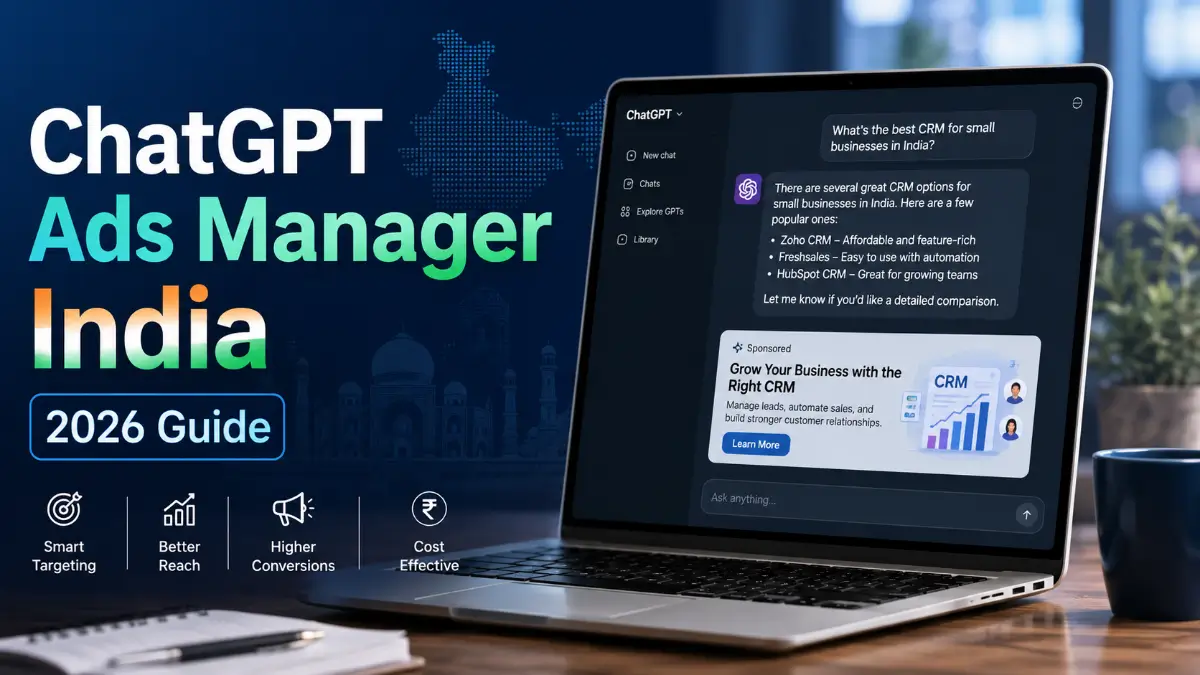
Quick answer: ChatGPT Ads Manager is OpenAI’s advertising platform for creating and managing campaigns that can appear within the ChatGPT experience. India is now included in OpenAI’s self-service Ads Manager availability. Advertisers can create campaigns, choose objectives, set budgets and dates, select countries and platforms, organize ads into ad groups, and monitor campaign performance.
TL;DR: ChatGPT Ads Manager India in 5 Points
- ChatGPT Ads Manager India is now available for self-service advertising, following OpenAI’s global expansion announced in August 2026.
- Businesses can use Ads Manager to create campaigns, select objectives, define budgets and dates, choose geographic and platform targeting, and monitor results.
- ChatGPT advertising is different from traditional search advertising because ads can be matched with the context of what people are exploring in a conversation.
- There is no single universal ChatGPT Ads cost for every Indian business. Pricing and campaign economics depend on factors such as the buying model, objective, audience, competition, creative and landing page.
- For Indian businesses, ChatGPT Ads could be especially interesting for products and services that require research, comparison or consideration before purchase.
What Is ChatGPT Ads Manager India?
ChatGPT Ads Manager India refers to the self-service advertising platform that allows businesses in India to create, launch and manage advertising campaigns on ChatGPT.
Think of it as a campaign management dashboard, similar in broad purpose to the platforms marketers already use for Google, Meta and other digital advertising channels.
The difference is the environment.
A traditional search ad is generally triggered by a search query. A social media ad is often delivered within a feed based on audience and platform signals.
ChatGPT advertising is designed around a conversational environment.
A person might ask:
“What’s a good accounting tool for a small business?”
Or:
“Compare project management software for a 20-person startup.”
Or:
“Which laptop should I buy for video editing under my budget?”
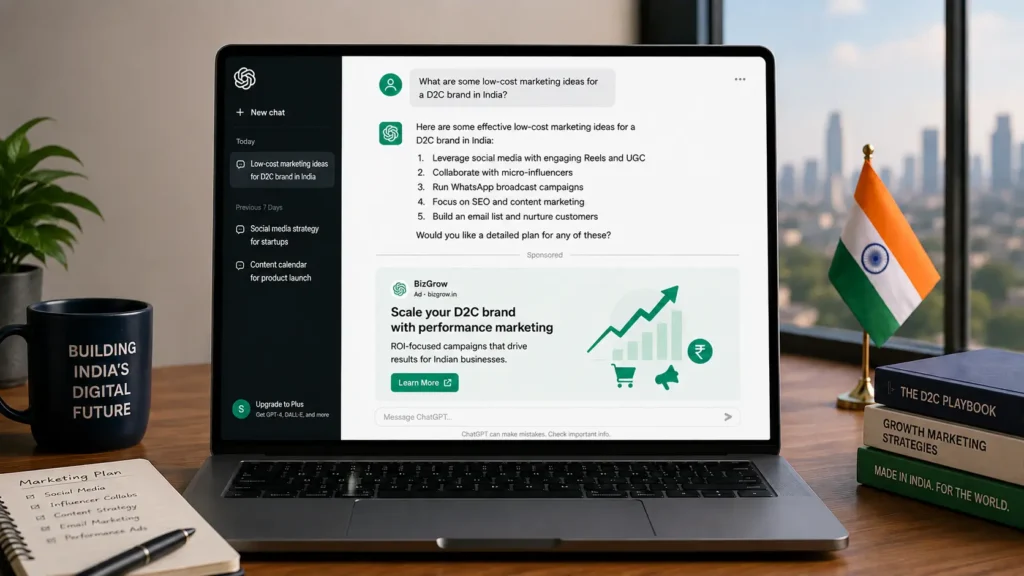
When advertising is relevant to that type of conversation, ChatGPT can display a clearly identified sponsored ad separately from the organic answer. OpenAI says advertising does not influence the answers ChatGPT provides.
That distinction is important for both advertisers and users.
Is ChatGPT Ads Manager Available in India?
Yes.
OpenAI announced on August 31, 2026 that self-service ChatGPT advertising was expanding to India, along with Europe, the Middle East and North Africa.
This means Indian businesses no longer have to treat ChatGPT advertising as a purely experimental U.S. opportunity.
The self-service model is particularly significant for smaller companies and startups because OpenAI says the introduction of Ads Manager has already opened the platform to small and medium-sized businesses.
Businesses can begin through the official advertising platform:
Advertise in ChatGPT with OpenAI
Important: Availability does not mean every campaign or business is automatically approved. Advertising eligibility, policies, account requirements and available features can change as the platform develops.
How Does ChatGPT Advertising Work?
The basic process is straightforward.
1. A business creates a campaign
The advertiser defines the purpose of the campaign, budget, dates and other campaign settings.
2. The advertiser chooses a campaign objective
OpenAI’s advertising system supports campaign objectives including CPM, CPC and oCPC, according to its Ads Manager documentation.
The appropriate objective depends on whether the advertiser is primarily trying to generate exposure, clicks or optimized outcomes.
3. The advertiser chooses geographic targeting
Countries can be selected at the campaign level.
For an Indian company, this makes India a natural starting point when the product or service is designed for Indian customers.
4. Ads are organized into ad groups
Ad groups allow advertisers to organize campaigns around focused themes or user needs.
For example, an online software company could create separate themes around:
- Accounting software
- Payroll software
- GST tools
- Invoicing software
This creates a more organized campaign structure than putting every product and audience into one broad group.
5. The advertiser creates the ad
OpenAI recommends clear, specific and benefit-focused advertising copy.
Rather than writing:
“The Best Software Ever.”
A stronger approach would be:
“Automate invoices and simplify GST billing for your growing business.”
The second version tells the reader exactly what the product does and who it is for.
6. The advertiser monitors performance
Ads Manager provides campaign performance information such as impressions, clicks and spend, along with reporting and export capabilities.
The platform is still evolving, so advertisers should expect features, controls and reporting options to change over time.
ChatGPT Ads Manager India: How to Use It
If you are wondering ChatGPT Ads Manager India how to use it, start with a simple campaign rather than trying to advertise your entire business at once.
Step 1: Define one business goal
Choose one measurable objective.
For example:
- Generate website visits
- Generate leads
- Promote a product
- Increase awareness
- Drive conversions
A campaign with one clear objective is easier to evaluate.
Step 2: Choose your Indian audience
Start with the geography that actually matters to your business.
If you sell nationwide, India may make sense.
If your service is limited to certain cities, your broader campaign strategy should reflect that business reality.
Do not target the entire country simply because the option exists.
Step 3: Build focused ad groups
Suppose you sell accounting software.
Instead of creating one generic ad group called “Software,” consider separate themes such as:
| Ad Group | User Need |
| GST Software | Businesses looking for GST tools |
| Invoicing | Businesses needing invoice automation |
| Small Business Accounting | Owners researching accounting software |
| Payroll | Businesses researching salary and payroll tools |
The purpose is to make the advertising message more relevant to the conversation theme.
Step 4: Write useful ad copy
Your ad should answer three questions quickly:
What is it?
Who is it for?
Why should I care?
Avoid exaggerated claims unless you can support them.
Step 5: Send visitors to a relevant landing page
This is one of the biggest opportunities for Indian businesses.
If the advertisement promotes GST billing software, the landing page should discuss GST billing software.
Do not send users to a generic homepage if a more relevant product page exists.
Google’s AdSense guidance also emphasizes relevant, original content, transparency and easy navigation.
Step 6: Measure before scaling
Do not increase spending simply because impressions are rising.
Look at:
- Click-through rate
- Cost per click
- Conversion rate
- Cost per acquisition
- Qualified leads
- Revenue
- Return on ad spend
A campaign producing cheap clicks but no customers is not necessarily successful.
ChatGPT Ads Targeting India: How Does It Differ?
One of the most interesting parts of ChatGPT advertising is its conversational context.
OpenAI explains that its advertising system can consider factors such as the current conversation, user intent, landing page and advertiser-provided context. Depending on the user’s settings and market, broader ChatGPT experience signals may also be used for ad personalization.
This is different from simply buying an exact keyword.
For example, a person may never type:
“best CRM software India.”
Instead, they might say:
“I run a 15-person sales team. We need something simple for tracking leads.”
The conversation itself provides useful information about the person’s need.
That makes conversational advertising particularly interesting for products where intent and context matter more than a single keyword.
However, advertisers should not interpret this as a guarantee that their ad will appear for a specific phrase.
OpenAI describes context hints as signals about topics, needs and situations, rather than exact-match keyword controls.
ChatGPT Ads Cost India: How Much Does It Cost?
This is one of the most searched questions around ChatGPT advertising India.
The short answer is: there is no single fixed price that applies to every advertiser in India.
Campaign cost depends on factors including:
- Campaign objective
- Buying model
- Bid strategy
- Competition
- Audience
- Creative quality
- Landing page experience
- Conversion performance
- Campaign duration
- Geographic targeting
OpenAI has introduced CPC bidding and other campaign objectives as its advertising platform has developed.
That means businesses should be careful with articles claiming that every Indian advertiser must pay a specific fixed daily amount.
The more useful question is:
“What customer acquisition cost can my business profitably afford?”
For example, imagine an Indian SaaS company makes ₹20,000 in gross profit from an average new customer.
It might be comfortable acquiring that customer for ₹3,000.
A different company with a ₹1,000 average order value may need a dramatically lower acquisition cost.
So instead of choosing a budget based on a headline number, calculate your economics first.
A simple starting framework
Maximum acceptable CPA = Profit per customer × acceptable acquisition percentage
Your actual calculation should account for margins, refunds, repeat purchases and lifetime value.
Who Can Advertise on ChatGPT in India?
The platform is designed for businesses and organizations that meet OpenAI’s advertising requirements.
Potential users include:
- Indian startups
- SaaS companies
- E-commerce brands
- Education companies
- Financial technology businesses
- Travel companies
- Professional services
- Consumer brands
- B2B companies
- Agencies managing advertising for clients
However, eligibility depends on OpenAI’s current policies and approval requirements.
Because the advertising platform is still developing, businesses should always check the latest requirements before planning a major campaign.
ChatGPT Ads for Indian Businesses: Who Should Try It First?
Not every company needs to rush into ChatGPT advertising.
The strongest candidates are businesses whose customers spend time researching before buying.
Good potential use cases
Software
People often compare software products before subscribing.
Education
Students and professionals frequently ask questions before choosing courses.
Travel
Travel decisions involve destinations, hotels, transportation and budgets.
Consumer electronics
Buyers often compare specifications and prices before purchasing.
Business services
B2B buyers may research solutions extensively before contacting a provider.
A less obvious opportunity
Indian startups could use ChatGPT advertising to reach customers at the consideration stage.
For example, instead of simply promoting:
“Buy our cybersecurity software.”
A campaign could focus on a user need:
“Protect your growing business without building a full internal security team.”
The second message fits a problem-solving conversation better.
ChatGPT Ads vs Google Ads in India
ChatGPT Ads should not automatically be viewed as a replacement for Google Ads.
They serve different environments.
| Factor | ChatGPT Ads | Google Ads |
| Environment | Conversational AI | Search and wider Google ecosystem |
| User behavior | Questions, exploration, comparison | Search queries and intent |
| Targeting | Conversation/context signals plus campaign controls | Keywords, audiences and other signals |
| Best opportunity | Research and consideration | Search demand and direct intent |
| Market maturity | Newer | Highly established |
| Reporting history | Still developing | Extensive |
| India opportunity | Newly expanding | Mature |
The smartest strategy for many businesses may eventually be testing both rather than choosing one exclusively.
Google can capture existing search demand.
ChatGPT may provide another route to people while they are exploring a decision.
ChatGPT Ads vs Meta Ads
Meta advertising is heavily associated with social discovery, audience targeting and visual content.
ChatGPT advertising operates in a different setting.
A simple comparison:
| Platform | Strongest Environment |
| Google Ads | Search intent |
| Meta Ads | Social discovery and audience targeting |
| ChatGPT Ads | Conversational discovery and consideration |
This does not mean one platform is universally better.
Your product, customer journey and economics should determine where you spend.
How Indian Businesses Can Write Better ChatGPT Ads
The biggest mistake would be treating ChatGPT Ads exactly like a banner advertisement.
People are already engaged in a conversation.
Your ad should therefore feel relevant to the problem being explored.
Weak example
“BUY NOW! BEST BUSINESS SOFTWARE IN INDIA!”
It is broad and promotional.
Stronger example
“Simplify invoices, payments and GST billing with one business platform.”
It explains the benefit without shouting.
Three practical rules
1. Lead with the customer problem.
Show that you understand what the person is trying to solve.
2. Make the benefit specific.
“Save time” is vague.
“Automate recurring invoices” is much clearer.
3. Match the landing page.
If the ad promises a specific feature, the visitor should immediately find that feature on the landing page.
Do ChatGPT Ads Change ChatGPT’s Answers?
No.
This is an important distinction.
OpenAI says ads are clearly labeled and separated from ChatGPT’s answers. It also states that advertising does not influence the answers ChatGPT provides.
That means advertisers are not buying the ability to rewrite an AI-generated answer.
For example, if someone asks ChatGPT to compare two products, an advertiser cannot simply pay to make ChatGPT declare its product the winner.
The advertisement remains separate from the answer.
Is ChatGPT Advertising Private?
OpenAI says advertisers do not receive users’ private conversations, chat history, memories, names, email addresses or precise location information.
Advertisers receive aggregated performance information such as views and clicks rather than individual users’ private chats.
This separation is important because conversational advertising would otherwise raise obvious privacy concerns.
OpenAI has also stated that users have controls over their advertising experience and personalization.
A Practical ChatGPT Ads Strategy for an Indian Startup
Suppose an Indian SaaS startup sells HR software.
Instead of launching one large national campaign immediately, start with a controlled test.
Campaign structure
Campaign: HR Software India
Ad Group 1: Payroll
Ad Group 2: Employee Attendance
Ad Group 3: HR Automation
Ad Group 4: Small Business HR
Then create several ad variations for each theme.
Example
A payroll-focused advertisement could emphasize:
- Salary processing
- Payroll automation
- Reducing manual work
- Small-business use cases
The landing page should then continue the same conversation.
This creates a simple funnel:
User need → Relevant ad → Relevant landing page → Conversion
That alignment matters more than simply increasing impressions.
Common ChatGPT Ads Mistakes to Avoid
1. Treating ChatGPT like Google Search
Do not assume exact keywords work the same way.
2. Using generic advertisements
A broad message can be less useful in a context-driven environment.
3. Sending traffic to the homepage
Use the most relevant landing page available.
4. Scaling before collecting data
Give your campaign enough time and meaningful conversion data before making major decisions.
5. Chasing clicks instead of customers
A high CTR is not the final goal.
Revenue and profitable conversions matter more.
6. Making unsupported claims
Avoid phrases such as “guaranteed #1” or “officially recommended by ChatGPT” unless you can substantiate them.
7. Assuming the platform is finished
It is not.
OpenAI is still expanding campaign formats, buying options, measurement capabilities and targeting features.
Is ChatGPT Ads Manager India Worth Trying in 2026?
For some businesses, yes.
But I would treat it as a testing opportunity, not as a guaranteed replacement for Google or Meta advertising.
ChatGPT has a different user experience.
People often arrive with a question rather than a traditional search query. They may explain their budget, preferences, constraints and goals in a single conversation.
That creates an interesting environment for brands that sell products requiring research and comparison.
For an Indian startup, the sensible approach is:
- Start with one clear customer problem.
- Create focused ad groups.
- Build several ad variations.
- Use relevant landing pages.
- Set a controlled test budget.
- Track conversions.
- Compare customer acquisition costs with other channels.
- Scale only after the economics make sense.
What Is the Future of ChatGPT Advertising in India?
The Indian market could become particularly important as ChatGPT advertising expands.
OpenAI says the platform is moving toward additional formats, objectives, buying options and measurement capabilities. It also highlights geographic targeting, product feeds, custom audiences and other capabilities as the system evolves.
That suggests the current version of ChatGPT Ads Manager may look considerably different a year from now.
The larger trend is even more interesting.
Advertising has traditionally been built around:
Search → Click → Website
Conversational advertising introduces another possibility:
Question → Exploration → Recommendation/Discovery → Action
If that model continues to develop, marketers may need to think less about individual keywords and more about customer problems, decision stages and conversational intent.
For Indian businesses, 2026 could therefore be an important early testing period.
Final Takeaway
ChatGPT Ads Manager India is no longer just a future possibility. It is now part of OpenAI’s expanding advertising platform.
OpenAI’s latest announcement shows how quickly the product has grown: ChatGPT Ads reached a $1 billion annualized revenue run rate in under 200 days, while self-service advertising expanded to India.
But businesses should resist the temptation to treat the platform as another copy of Google Ads or Meta Ads.
The real opportunity is the conversational environment.
People can explain what they need, compare options and ask follow-up questions before making a decision.
For Indian advertisers, the best strategy is therefore not simply to buy visibility.
It is to understand the problem the customer is trying to solve, create a relevant message and connect that message to a useful landing page.
That is where ChatGPT advertising could become genuinely valuable.
Want to experiment with ChatGPT Ads Manager India? Start small, measure conversions and scale only when the numbers support it.
Frequently Asked Questions About ChatGPT Ads Manager India
1. What is ChatGPT Ads Manager India?
ChatGPT Ads Manager India is OpenAI’s self-service advertising platform for businesses in India. It allows advertisers to create and manage campaigns, choose objectives, set budgets and dates, configure targeting and monitor campaign performance. OpenAI announced the expansion of self-service advertising to India in August 2026.
2. Is ChatGPT Ads Manager available in India?
Yes. OpenAI announced on August 31, 2026 that self-service ChatGPT advertising was expanding to India. Availability and features can change as the platform develops.
3. How can I use ChatGPT Ads Manager India?
Businesses can access OpenAI’s advertising platform, create a campaign, select an objective, configure budget and dates, choose available geographic and platform targeting, create focused ad groups and ads, then monitor campaign performance.
4. How much do ChatGPT Ads cost in India?
There is no single universal ChatGPT Ads cost India figure that applies to every advertiser. Costs depend on factors such as the campaign objective, buying model, competition, targeting, bids, creative and conversion performance. Businesses should evaluate cost against their own customer acquisition economics.
5. How does ChatGPT Ads targeting India work?
ChatGPT advertising can use the context of a conversation and other available campaign and advertising signals to determine relevance. OpenAI describes context hints as signals about topics, needs and situations rather than exact-match keyword targeting.
About the Author
Meenakshi is the founder and writer at SevenFeeds, covering technology, startups, AI and emerging digital trends. Her work focuses on explaining complex technology developments in a practical and easy-to-understand way for everyday readers, founders and technology enthusiasts.
Sources and Further Reading
For the most current information, readers should verify advertising availability and campaign requirements directly with OpenAI because the advertising platform is evolving.

One Comment