Author: Meenakshi
Published: September 5, 2026
Updated: September 5, 2026
Introduction
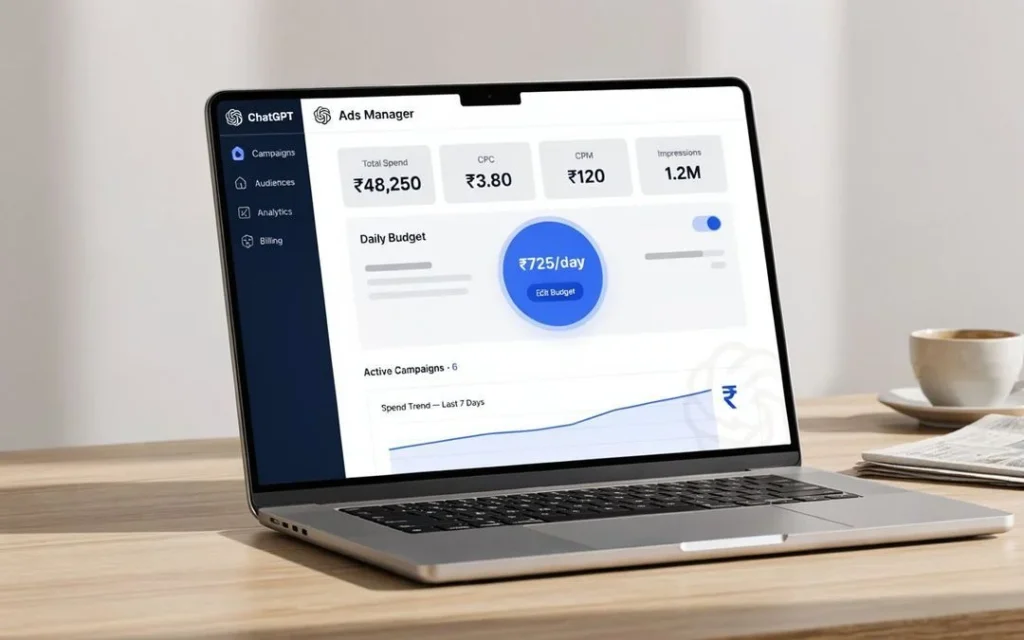
₹725 a day. That is the number getting the most attention around ChatGPT advertising in India right now.
But when I started looking at the actual Ads Manager information, I found an important distinction that is easy to miss: ₹725 is the minimum daily campaign spend, not the price you pay for every click or impression.
That difference matters if you are a startup founder, D2C owner or marketer deciding whether ChatGPT Ads deserves a place in your advertising budget.
In this guide, I will break down ChatGPT Ads Manager pricing India, including the ₹725 minimum, CPC, CPM, oCPC, monthly budget calculations and the numbers I think Indian businesses should actually watch before increasing their spend. OpenAI currently lists India among the markets with a ₹725 daily campaign minimum and supports CPM, CPC and oCPC campaign objectives.
What does ChatGPT Ads Manager cost in India?
Let’s start with the simplest answer.
The current minimum daily campaign spend for India is ₹725. OpenAI’s campaign documentation lists India at 725 INR as the daily minimum.
That gives us a useful starting point:
| Campaign period | Spend at ₹725/day |
| 1 day | ₹725 |
| 7 days | ₹5,075 |
| 14 days | ₹10,150 |
| 30 days | ₹21,750 |
| 60 days | ₹43,500 |
| 90 days | ₹65,250 |
These calculations are simply ₹725 multiplied by the number of days. They are not a guarantee of how much traffic, clicks or sales you will receive.
This is the first thing I would keep in mind before comparing ChatGPT Ads with other advertising platforms.
OpenAI says advertisers can choose either a campaign-total budget or a daily budget. The daily budget works as an average delivery target over a seven-day period, so actual daily spending can move above or below the selected amount.
Is ₹725 a fixed cost for ChatGPT Ads?
No.
This is probably the biggest misunderstanding around ChatGPT Ads Manager pricing India.
You are not paying ₹725 every time somebody clicks your advertisement.
Instead, ₹725 is the minimum daily campaign budget currently listed for India. What you actually pay depends on your selected campaign objective and the auction.
OpenAI currently supports three objectives:
| Objective | Pricing model | Main purpose |
| CPM | Cost per 1,000 impressions | Reach and awareness |
| CPC | Cost per click | Traffic and engagement |
| oCPC | Conversion-optimized CPC | Driving tracked conversions |
OpenAI says the advertising system uses a relevance-weighted, second-price auction. For CPC campaigns, advertisers set a maximum CPC bid, while the actual cost is determined by the auction.
So I would be careful with articles claiming that ChatGPT Ads in India already have a universal “₹X CPC.”
There is no single fixed CPC that every Indian advertiser pays.
CPC vs CPM vs oCPC: Which one should you choose?
This is where the pricing becomes more interesting.
CPC: Pay for valid clicks
CPC, or cost per click, is probably the easiest model to understand.
If your objective is to bring people from ChatGPT to your website, product page or signup page, CPC is the model worth looking at first.
For example, imagine I am promoting a technology product and my campaign receives 200 valid clicks.
If the campaign spends ₹10,000, the average CPC would be:
₹10,000 ÷ 200 = ₹50 per click
That ₹50 is an example calculation, not a published ChatGPT Ads India rate.
OpenAI describes CPC as an objective designed around engagement and traffic.
CPM: Pay for impressions
CPM means cost per 1,000 impressions.
This makes more sense when the goal is visibility rather than immediate website traffic.
A startup launching a new brand, for example, might care about how many relevant users see its advertisement.
CPM is therefore more closely connected to reach and awareness, while CPC is more directly connected to traffic.
oCPC: Optimize toward conversions
oCPC is the option I find most interesting for performance advertisers.
It is designed to optimize delivery toward a specific conversion event after a user clicks.
That could be a:
- Purchase
- Signup
- Lead submission
- Other supported conversion event
There is an important detail here: oCPC does not mean you pay per conversion.
OpenAI says billing remains based on valid clicks, while the system uses predicted conversion likelihood to optimize delivery toward the selected conversion event.
For oCPC, you also need conversion tracking properly configured.
—##How much would ChatGPT Ads cost per month?
If you are a small Indian business, thinking in monthly numbers is probably easier than thinking in daily budgets.
At the current minimum:
₹725 × 30 = ₹21,750
So a month at the minimum daily budget would be around ₹21,750.
But I would not automatically recommend spending ₹21,750 simply because that is the minimum monthly equivalent.
First ask yourself:
What am I trying to get from that money?
For example:
| Daily budget | Approx. 30-day spend | Suitable testing idea |
| ₹725 | ₹21,750 | Initial platform test |
| ₹1,000 | ₹30,000 | Small traffic test |
| ₹1,500 | ₹45,000 | More data and creative testing |
| ₹2,500 | ₹75,000 | Larger performance test |
| ₹5,000 | ₹1,50,000 | Scaling after validation |
These are planning examples, not OpenAI’s recommended budgets.
I would rather see a business spend ₹725 a day with proper tracking than ₹5,000 a day without knowing where the money is going.
How I would test ChatGPT Ads with a small budget
If I were planning a first campaign for an Indian startup, I would resist the temptation to launch five products, three audiences and ten different messages at once.
I would keep the first experiment focused.
1. Choose one product
Don’t advertise the entire business.
Pick the product or service with the clearest customer value.
2. Choose one measurable goal
For example:
Get demo requests.
Or:
Generate ecommerce purchases.
Or:
Drive qualified website traffic.
3. Start with a controlled budget.
The current India minimum gives advertisers a relatively accessible starting point.
For example:
₹725 × 14 days = ₹10,150
That gives you a small initial testing window.
4. Track what happens after the click
This is the part I would not skip.
A click is not a customer.
The journey should look something like:
Ad → Click → Landing page → Signup/Lead → Customer → Revenue
OpenAI’s Ads Manager reporting includes metrics such as impressions, clicks, spend, CTR, average CPC, average CPM and conversions. UTM parameters can also be used to track traffic in existing analytics tools.
ChatGPT Ads vs Google Ads vs Meta Ads
I don’t think it makes sense to ask whether ChatGPT Ads is automatically “better” than Google or Meta.
They are reaching people in different situations.
| Platform | Advertising environment | Strongest opportunity |
| Google Ads | Search | Capturing existing demand |
| Meta Ads | Social feeds | Product discovery and audience targeting |
| ChatGPT Ads | Conversations | Reaching users while researching and deciding |
Someone using Google may already know what they want.
Someone scrolling Instagram may not have been planning to buy anything.
A ChatGPT user could be somewhere in between. They may be actively trying to understand a problem, compare options or decide what to purchase.
OpenAI says its ad system considers the context and intent of the current conversation, along with the ad’s landing page, copy and advertiser-provided context hints.
That is what makes this advertising channel worth watching.
Why the real number is customer acquisition cost
Here’s where I think many businesses will make a mistake.
They will compare CPC.
“ChatGPT gave me a ₹60 CPC.”
“Google gave me a ₹45 CPC.”
And then they will conclude Google is cheaper.
That conclusion may be completely wrong.
Imagine:
ChatGPT Ads:
₹60 CPC × 100 clicks = ₹6,000 spend
10 customers = ₹600 CAC
Google Ads:
₹45 CPC × 100 clicks = ₹4,500 spend
4 customers = ₹1,125 CAC
Google generated cheaper clicks.
ChatGPT generated cheaper customers.
That’s why I would track CAC and ROAS, not just CPC.
For ecommerce, the formula is simple:
ROAS = Revenue ÷ Advertising Spend
For customer acquisition:
CAC = Advertising Spend ÷ New Customers
Those numbers tell you much more about whether your campaign deserves more money.
Who should consider ChatGPT Ads in India?
I think ChatGPT Ads is particularly worth testing for businesses where customers need information before making a decision.
SaaS businesses
Software buyers often compare features, prices and alternatives before signing up.
D2C brands
Products that require research or comparison could be a natural fit.
Think skincare, fitness products, consumer technology or other considered purchases.
Startups
For a startup, testing an emerging channel early can provide useful learning before the advertising market becomes more mature.
Professional services
Businesses selling consulting, technology services or other expertise-driven offerings may also find the conversational environment interesting.
But I would wait if your business has no conversion tracking, no clear landing page and no idea what a new customer is worth.
A new advertising channel cannot solve an unclear acquisition strategy.
Why It Matters for Indian Advertisers
The interesting part of ChatGPT Ads is not simply that another advertising platform has arrived.
It is that advertising is entering a different type of environment.
Search advertising is built around queries. Social advertising is built around feeds and audiences. ChatGPT advertising is being developed around conversations, where the user’s intent can be much more detailed than a short search phrase.
That does not mean an advertiser can choose a keyword and force an ad into every conversation containing it. OpenAI specifically says context hints are not exact-match keywords and do not guarantee delivery in specific conversations.
For Indian marketers, I think the first phase should be about learning rather than blindly scaling.
The brands that understand which conversations, messages, products and landing pages produce valuable customers will have a much better foundation than brands that simply chase cheap clicks.
Conclusion
After looking at the current pricing information, I would not describe ChatGPT Ads as a cheap alternative to Google Ads or Meta Ads. We simply do not have enough mature India-specific performance data yet to make that claim responsibly.
What we do know is that the entry point is currently ₹725 per day, with CPM, CPC and oCPC available as campaign objectives.
For me, the more interesting question is what happens after the click.
If a ₹725-a-day campaign brings visitors who actually sign up, purchase or become qualified leads, the platform becomes much more interesting. If it produces impressions and clicks but no business value, increasing the budget only increases the loss.
So my advice to Indian advertisers is simple: start small, measure everything, learn what works and scale only when the economics make sense.
ChatGPT Ads is still a developing advertising platform. Pricing, bidding options, targeting capabilities and measurement tools can change, so I would check the latest OpenAI documentation before making a major campaign decision.
ChatGPT Ads Manager Pricing India: FAQ
What is the minimum ChatGPT Ads budget in India?
OpenAI currently lists ₹725 per day as the minimum campaign spend for India.
How much is ChatGPT Ads per month in India?
At the current ₹725 daily minimum, 30 days would equal approximately ₹21,750. Actual campaign spending depends on the budget and delivery settings you choose.
Does ChatGPT Ads have a fixed CPC in India?
No. There is not one fixed CPC that applies to every Indian advertiser. CPC campaigns use an auction, so actual costs depend on the campaign and auction conditions.
What is the difference between CPC and CPM?
CPC means cost per click, while CPM means cost per 1,000 impressions. CPC is generally more closely associated with traffic, while CPM is designed around reach and awareness.
What is oCPC in ChatGPT Ads?
oCPC is conversion-optimised cost per click. It uses conversion signals to optimize delivery toward a selected conversion event, but advertisers are still billed for valid clicks rather than conversions.
Is ₹725 enough for a ChatGPT Ads test?
It can be a reasonable starting point for testing, but the right budget depends on your product, conversion rate, customer value and advertising goal. The minimum budget alone does not tell you whether a campaign will be profitable.
Sources
- OpenAI Help Center: Create Campaigns for ChatGPT Ads
- OpenAI Help Center: Ads in ChatGPT – The Basics
- OpenAI Help Center: Conversion-optimized Campaigns
- OpenAI Help Center: Billing & Payment for ChatGPT Ads
Author
Meenakshi
Technology & Startup Writer
Meenakshi writes about artificial intelligence, technology, startups and the changing digital economy. She focuses on explaining new technology in simple language while looking at what it actually means for businesses and users.
Related Articles
- ChatGPT Ads Manager India: Complete Guide for Businesses
- ChatGPT Ads Targeting in India: How Conversational Advertising Works
- ChatGPT Ads vs Google Ads vs Meta Ads: Which Is Better for Indian Businesses?
- ChatGPT Ads for Indian Businesses: Strategies for Startups, D2C Brands and Local Companies
- How to Use ChatGPT Ads Manager in India: Step-by-Step Guide for Businesses