
Published: May 2025 | ✅ Last Updated: March 16, 2026 Author: SevenFeeds Editorial Team | Reading Time: 15 minutes
✅ 2026 Updated: This guide includes Budget 2026 announcements, Fund of Funds 2.0 (₹10,000 crore), the new Deep Tech startup category (DPIIT, February 2026), Mudra Tarun Plus expansion, and the GeM Startup Runway programme.
Table of Contents
ToggleWhy 2026 Is the Best Year Yet to Access Startup Schemes in India {#why-2026}
India now has over 2,07,000 DPIIT-recognized startups — making it the world’s third-largest startup hub. Those startups collectively provide over 21.9 lakh direct jobs, and the government’s commitment to them has never been larger or better funded.
Finance Minister Nirmala Sitharaman’s Union Budget 2026-27, presented on February 1, 2026, was the most startup-friendly budget in India’s history. The headline number: three separate ₹10,000 crore funds targeting startups, MSMEs, and deep-tech innovation — plus a ₹2,000 crore injection into existing support infrastructure. That is ₹32,000 crore in new government money flowing into India’s startup ecosystem this year.
On February 4, 2026, DPIIT went further — formally recognizing Deep Tech startups as a distinct category for the first time, acknowledging that AI, semiconductor, quantum computing, and space tech companies need different support timelines than consumer internet startups.
For founders who understand which scheme fits their stage and know how to apply correctly, 2026 represents a rare window of capital access, tax relief, and institutional support that did not exist even two years ago.
This guide covers all 15 active government schemes for startups in India 2026 — with the funding amounts, eligibility, how to apply, and the mistakes that get applications rejected.
India’s startup ecosystem in 2025 is among the fastest-growing globally, boasting over 120,000 registered startups in diverse sectors like fintech, agritech, healthtech, and deep-tech. This surge is driven by young entrepreneurs, widespread digital adoption, and expanding internet access in rural areas.This article highlights key trends, challenges, and opportunities for Women-Led GenAI Startups in India 2025.
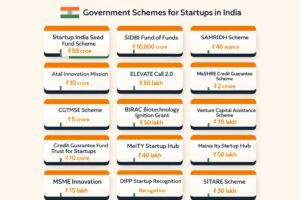
Master Comparison Table: All 15 Schemes at a Glance {#master-table}
This is the table no competitor provides — every scheme compared on the metrics that matter most to founders.
Top Government Schemes for Startups in India 2025
If you’re starting a business this year, understanding the right government schemes for startups in India 2025 can save both time and capital.
Overview and Objectives
Launched in January 2016, Startup India aims to foster a robust ecosystem that supports innovation and entrepreneurship. Its goals include simplifying business processes, creating jobs, and promoting sustainable economic growth.
Key Benefits
- Tax exemptions: 3-year income tax exemption under Section 80 IAC and capital gains tax exemption in certain cases.
- Self-certification: Compliance with 6 labor and 3 environmental laws can be self-certified for 5 years.
- Startup India Hub: A single platform offering advice, funding guidance, resources, and intellectual property help.
Eligibility Criteria and Registration Process
- Must be a private limited company, LLP, or registered partnership.
- Less than 10 years old.
- Annual turnover under ₹100 crore in any prior financial year.
- Working on innovative product/service/process development or commercialization.
Register on the Startup India portal and seek DPIIT approval.
Not sure how to do that? Read our step-by-step guide on Startup Registration in India to make the process easier.
Schemes for Startups in India
1.Fund of Funds (FFS) for Startups
Managed by SIDBI
FFS, managed by SIDBI, boosts startups indirectly by funding SEBI-registered Alternative Investment Funds (AIFs).
Support for Venture Capital Funding
FFS funds AIFs which invest in startups, leveraging professional expertise to increase access to early-stage capital.
Impact on Seed and Early-Stage Startups
It improves funding availability at critical growth phases where startups face the most difficulty.
Application Process and Access to Funding
Startups approach AIFs supported by SIDBI, which independently evaluate and invest. AIF lists are available on the SIDBI website. This makes FFS a valuable part of government schemes for startups in India 2025 focused on solving early-stage capital challenges.
2. Startup India Seed Fund Scheme (SISFS)
What It Offers
Among the most critical government schemes for startups in India 2025, SISFS stands out for idea validation and early-stage funding.
- Grants up to ₹20 lakh for idea validation, prototype, and testing.
- Seed funding up to ₹50 lakh for market entry, commercialization, or scaling.
Who Is Eligible
- DPIIT-recognized startups.
- In idea, prototype, or early product stage.
- Less than 2 years old.
- Not received more than ₹10 lakh under any other scheme.
Incubator Support and How to Apply
Funding is routed through approved incubators. Apply via Startup India portal; incubators evaluate based on innovation, market potential, and team.
3.Credit Guarantee Scheme for Startups (CGSS)
What It Is
CGSS provides collateral-free loans up to ₹10 crore to startups, encouraging innovation without the need for personal guarantees.
Key Features
- Loan tenure up to 5 years.
- Participating financial institutions include banks, NBFCs, and SIDBI.
- Credit guarantee covers up to 80% of the loan.
How to Avail and Who Benefits
DPIIT-recognized startups approach participating lenders with a business plan. Product-based, manufacturing, deep-tech startups, and founders lacking collateral benefit most.
4. MSME Support Schemes for Startups
Importance of Udyam Registration
Udyam Registration unlocks benefits like government tenders, subsidies, and priority sector lending.
Key Schemes
- Credit Linked Capital Subsidy Scheme (CLCSS): Up to 15% capital subsidy (max ₹15 lakh) for tech upgrades.
- Technology and Quality Upgradation Support (TEQUP): Financial aid for adopting energy-efficient tech and quality certification
Relevance for Startups
These are among the lesser-known government schemes for startups in India 2025, ideal for manufacturing, electronics, engineering, and tech startups, helping reduce costs, modernize production, and enhance competitiveness.
5. Mudra Loan (Pradhan Mantri Mudra Yojana – PMMY)
Types of Loans
- Shishu: Up to ₹50,000 for startups in idea or early stage.
- Kishore: ₹50,001 to ₹5 lakh for growing businesses.
- Tarun: ₹5 lakh to ₹10 lakh for established businesses.
Who Can Apply
Micro and small businesses in service, retail, freelancing, and trading sectors. No collateral required.
Benefits for Startups
Easy working capital access for equipment, inventory, shop upgrades, and digital transformation.
6. Atal Innovation Mission (AIM)
Why It Is Important
AIM fosters innovation and entrepreneurship, especially for deep-tech and social impact startups.
Key Features
- Atal Incubation Centres (AIC): Mentorship, co-working, seed funding, investor access.
- Support from ideation to prototype development.
- Encourages collaborations in AI, IoT, robotics, cleantech, and agri-tech.
7. Digital India and MeitY Startup Hub (MSH)
Why It Matters
MeitY Startup Hub supports tech startups in AI, blockchain, IoT, cybersecurity, and other emerging fields.
Key Features
- Funding and technology guidance.
- Incubation and mentorship programs.
- Collaboration with state governments, corporates, and academia.
State-specific Startup Policies in India
Why Local Support Is Crucial
States like Gujarat, Kerala, and Karnataka provide localized incentives, incubation, and funding beyond major hubs.
Key Features
- Seed funding, co-working spaces, grants, and R&D support.
- Tax exemptions, patent reimbursement, and marketing assistance.
- State-run incubators and mentorship networks.
Key Tips to Leverage These Startup Schemes
- Stay Updated: Regularly check Startup India Hub, MeitY Startup Hub, and state websites.
- Documentation and Compliance: Maintain Udyam registration, DPIIT recognition, GST, PAN, and updated business plans.
- Choose Right Scheme: Match schemes to your startup stage and sector—seed funding for ideas, credit schemes for revenue stage, tech grants for specialized startups.
- Explore relevant central government schemes for startups in India 2025 based on your business model, stage, and sector.
Conclusion: Unlock Growth with Government Schemes for Startups
The Government of India offers powerful schemes to boost your startup journey—from funding and incubation to credit support and tech innovation grants. No matter your stage, there is a scheme designed to help you grow faster and smarter. To fully leverage government schemes for startups in India 2025, startups should stay compliant and updated
FAQs
The best government schemes for startups in India 2025 include the Startup India Seed Fund, Fund of Funds (FFS), Credit Guarantee Scheme, and MSME support schemes.
Startups recognized by DPIIT, less than 10 years old with innovative business models, and turnover under ₹100 crore can apply for these schemes.
Startups can apply via the Startup India portal. Approved incubators evaluate applications based on innovation, market readiness, and the founding team.
Essential documents include DPIIT certificate, Udyam registration (for MSMEs), GST details, business plan, pitch deck, and bank account details.
Yes, sectors like fintech, agritech, deeptech, and manufacturing have special support through schemes like MeitY Startup Hub, AIM, and MSME-specific subsidies.