



Published: May 2025 | ✅ Last Updated: March 16, 2026 Author: SevenFeeds Editorial Team | Reading Time: 15 minutes
✅ 2026 Updated: This guide includes Budget 2026 announcements, Fund of Funds 2.0 (₹10,000 crore), the new Deep Tech startup category (DPIIT, February 2026), Mudra Tarun Plus expansion, and the GeM Startup Runway programme.
Table of Contents
ToggleWhy 2026 Is the Best Year Yet to Access Startup Schemes in India {#why-2026}
India now has over 2,07,000 DPIIT-recognized startups — making it the world’s third-largest startup hub. Those startups collectively provide over 21.9 lakh direct jobs, and the government’s commitment to them has never been larger or better funded.
Finance Minister Nirmala Sitharaman’s Union Budget 2026-27, presented on February 1, 2026, was the most startup-friendly budget in India’s history. The headline number: three separate ₹10,000 crore funds targeting startups, MSMEs, and deep-tech innovation — plus a ₹2,000 crore injection into existing support infrastructure. That is ₹32,000 crore in new government money flowing into India’s startup ecosystem this year.
On February 4, 2026, DPIIT went further — formally recognizing Deep Tech startups as a distinct category for the first time, acknowledging that AI, semiconductor, quantum computing, and space tech companies need different support timelines than consumer internet startups.
For founders who understand which scheme fits their stage and know how to apply correctly, 2026 represents a rare window of capital access, tax relief, and institutional support that did not exist even two years ago.
This guide covers all 15 active government schemes for startups in India 2026 — with the funding amounts, eligibility, how to apply, and the mistakes that get applications rejected.
India’s startup ecosystem in 2025 is among the fastest-growing globally, boasting over 120,000 registered startups in diverse sectors like fintech, agritech, healthtech, and deep-tech. This surge is driven by young entrepreneurs, widespread digital adoption, and expanding internet access in rural areas.This article highlights key trends, challenges, and opportunities for Women-Led GenAI Startups in India 2025.
Master Comparison Table: All 15 Schemes at a Glance {#master-table}
This is the table no competitor provides — every scheme compared on the metrics that matter most to founders.
# | Scheme | Max Funding | Stage | Equity Dilution? | Apply Via | 2026 Update |
1 | Startup India / DPIIT | Gateway to all | Any | No | startupindia.gov.in | New Deep Tech category |
2 | SISFS Seed Fund | ₹50 lakh | Idea/Early | No (grant) | Startup India portal | Active — apply now |
3 | Fund of Funds 2.0 | Indirect (via AIFs) | Early/Growth | Yes (VC) | SIDBI-backed AIFs | +₹10,000 Cr corpus |
4 | CGSS | ₹10 crore | Any | No (loan) | Partner banks | Active |
5 | 80-IAC Tax Holiday | Tax saving | Revenue stage | No | Inter-Ministerial Board | Extended to 2030 |
6 | Mudra Tarun Plus | ₹20 lakh | Early/Growth | No (loan) | Any bank / NBFC | Limit raised in Budget 2026 |
7 | Atal Innovation Mission | Incubation + seed | Idea/Proto | No | aim.gov.in | Active |
8 | MeitY Startup Hub | Tech grants | Tech startups | No | startup.meity.gov.in | Active |
9 | PLI Scheme | 4–6% output incentive | Manufacturing | No | Sector ministries | Active across 14 sectors |
10 | GeM Startup Runway | Government revenue | Revenue stage | No | gem.gov.in | Active 2026 |
11 | CGTMSE | ₹5 crore | MSME stage | No (loan) | Partner banks | Active |
12 | Deep Tech Programme | TBD (Q3 2026) | Deep tech | TBD | DPIIT portal | NEW — Feb 2026 |
13 | IN-SPACe | Space-specific grants | Space tech | No | inspaceind.in | Active |
14 | CLCSS | ₹15 lakh subsidy | Manufacturing | No | SIDBI/banks | Active |
15 | State Schemes | Varies by state | Any | No | State startup portals | Check your state |
Scheme 1: Startup India & DPIIT Recognition — Your Gateway to Everything {#startup-india}
What it is: DPIIT recognition is not a funding scheme itself — it is the master key that unlocks every other scheme on this list. Without it, you cannot access SISFS, CGSS, the tax holiday, Fund of Funds, or the new Deep Tech programme.
What recognition gives you:
- 3-year income tax exemption (Section 80-IAC) eligibility
- Self-certification compliance for 6 labor and 3 environmental laws
- Fast-tracked IPR filing with 80% rebate on patent fees
- Access to the Startup India Hub for funding, mentorship, and networking
- GeM marketplace access for government procurement
Eligibility (2026):
Criteria | Requirement |
Business type | Private Limited Company, LLP, or Registered Partnership |
Age | Less than 10 years from date of incorporation |
Annual turnover | Under ₹100 crore in any prior financial year |
Core activity | Innovative product, service, or process development |
Deep Tech (new 2026) | Separate category — up to 15 years recognition proposed |
How to apply (exact steps):
- Visit startupindia.gov.in and create a founder account
- Click “Get DPIIT Recognition” and fill the application
- Upload: Incorporation certificate, PAN, and a 200-word description of your innovation
- Submit — DPIIT review takes approximately 2–4 weeks
- Receive DPIIT Recognition Number — your gateway certificate
Pro tip: Many founders delay applying because they think their idea is not “innovative enough.” DPIIT’s definition is deliberately broad — if your product, service, or business model is meaningfully different from what already exists in the market, you qualify. Apply first; refine later.
Scheme 2: Startup India Seed Fund Scheme (SISFS) {#sisfs}
| Type | Amount | Purpose | Equity? |
|---|---|---|---|
| Soft loan / Convertible debenture | Up to ₹20 lakh | Proof of concept, prototype, product trials | ❌ No |
| Medical devices | Up to ₹50 lakh | Market entry, commercialization, scaling | ❌ No |
- DPIIT-recognized startup
- Less than 2 years old at time of application
- In idea, prototype, or early product stage
- Has not received more than ₹10 lakh from any other government scheme
- Get DPIIT recognition first (Scheme 1 above)
- Visit startupindia.gov.in → “SISFS” section
- Browse the list of approved incubators in your city or sector
- Apply directly to 2–3 incubators whose focus matches your startup
- Incubators evaluate: innovation potential, market size, founding team
- If selected, funding is disbursed in tranches tied to milestones
Scheme 3: Fund of Funds for Startups 2.0 (FFS) {#ffs}
What it is: India’s largest startup funding vehicle — a government fund that invests in SEBI-registered Alternative Investment Funds (AIFs), which in turn invest in startups.
Budget 2026 update: The government injected an additional ₹10,000 crore into FFS in Budget 2026-27, specifically targeting AI, deep tech, and early-stage innovation. SIDBI had already committed ₹11,808 crore to various AIFs under the original FFS as of December 2025.
How it works: Government → SIDBI → SEBI-registered AIFs → Your Startup
You do not apply directly to SIDBI. You approach AIFs that are funded by SIDBI. These AIFs invest like venture capital — in exchange for equity.
How to find the right AIF:
- Visit sidbi.in and browse the list of SIDBI-backed AIFs
- Identify AIFs focused on your sector (fintech, agritech, deeptech, etc.)
- Apply directly to the AIF’s portfolio company application process
- SIDBI-backed AIFs typically take 2–4 months from first contact to term sheet
Who benefits most: Startups at the seed-to-Series A stage that have a working prototype, early revenue or pilots, and are raising ₹50 lakh to ₹5 crore.
Scheme 4: Credit Guarantee Scheme for Startups (CGSS) {#cgss}
What it is: CGSS enables DPIIT-recognized startups to access collateral-free loans up to ₹10 crore. The government provides a credit guarantee covering up to 80% of the loan — meaning the bank risks only 20% of the principal, making them far more willing to lend to startups without assets.
Key features:
| Feature | Detail |
|---|---|
| Maximum loan | ₹10 crore |
| Guarantee coverage | Up to 80% of loan amount |
| Loan tenure | Up to 5 years |
| Collateral required | ❌ None |
| Personal guarantee | ❌ None required |
| Lending institutions | Banks, NBFCs, SIDBI |
Eligibility:
- DPIIT-recognized startup
- Viable business plan demonstrating repayment capacity
- Not defaulted on any previous government-scheme loan
How to apply:
- Prepare a detailed business plan (20–30 pages minimum)
- Include financial projections for 3 years with revenue assumptions
- Approach any CGSS partner bank or NBFC with your DPIIT certificate + business plan
- Bank conducts due diligence and submits for CGSS guarantee
- On approval, funds typically disbursed within 30–60 days
Who benefits most: Deep tech, manufacturing, and product startups that need capital for equipment, inventory, or working capital but do not have physical assets to pledge as collateral.
Scheme 5: Section 80-IAC Income Tax Holiday {#tax-holiday}
What it is: DPIIT-recognized startups can claim 100% income tax exemption for any 3 consecutive financial years within their first 10 years of incorporation. This means zero tax on profits during your chosen 3-year period.
Budget 2025-26 extension: The window to apply for this exemption was extended through March 31, 2030 — giving newly incorporated startups in 2026 full access to this benefit.
How much can you save? A startup earning ₹2 crore profit in year 4 would normally pay ₹52 lakh in corporate tax (26%). With 80-IAC, that is ₹52 lakh saved — in a single year.
How to apply:
- File an application on the Startup India portal for 80-IAC certification
- Submit to the Inter-Ministerial Board (IMB) for review
- IMB evaluates: innovation quality, growth potential, and scalability
- Approval typically takes 3–6 months
- Once approved, file for exemption in your Income Tax Return (ITR) under Section 80-IAC
Critical advice from CAs: Do not automatically apply for the exemption in year 1. Apply in the years when your startup is most profitable. Many founders waste the exemption in pre-revenue years when there was no tax liability anyway. Plan your 3-year window with a CA.
Scheme 6: Mudra Loan — Pradhan Mantri Mudra Yojana (PMMY) {#mudra}
What it is: Collateral-free working capital loans for micro and small businesses — available to virtually any registered business, not just DPIIT-recognized startups.
Loan categories (updated for 2026):
| Category | Loan Amount | Target Stage |
|---|---|---|
| Shishu | Up to ₹50,000 | Idea / pre-revenue |
| Kishore | ₹50,001 – ₹5 lakh | Early operations |
| Tarun | ₹5 lakh – ₹10 lakh | Growing business |
| Tarun Plus (NEW 2026) | ₹10 lakh – ₹20 lakh | Expanding business |
Budget 2026 update: The government introduced a new Tarun Plus category in Budget 2026, raising the maximum Mudra loan from ₹10 lakh to ₹20 lakh. Over 48 million Mudra loans have been approved since inception.
How to apply:
Prepare a brief business plan (2–5 pages is sufficient for Mudra)
Visit any nationalized bank, regional rural bank, MFI, or NBFC
Submit: Aadhaar, PAN, business registration proof, and last 6 months’ bank statement
No formal DPIIT recognition required — open to all micro/small businesses
Approval typically in 1–3 weeks for Shishu/Kishore; 3–6 weeks for Tarun/Tarun Plus
Scheme 7: Atal Innovation Mission (AIM) {#aim}
What it is: AIM is NITI Aayog’s flagship initiative to build innovation and entrepreneurship culture, primarily through Atal Incubation Centres (AICs) and Atal Community Innovation Centres (ACICs).
What AIM provides:
- Incubation at AICs: Co-working space, mentorship, seed funding access, investor connects
- Focus sectors: AI, IoT, robotics, cleantech, agritech, and deep tech
- Support from ideation through prototype development
- Connections to 10,000+ Atal Tinkering Labs in schools for EdTech startups
Who benefits most: Pre-revenue deep tech and hardware startups that need physical infrastructure, technical mentorship, and government backing before approaching private VCs.
Apply at: aim.gov.in
Scheme 8: MeitY Startup Hub (MSH) {#meity}
What it is: The Ministry of Electronics and IT’s dedicated support programme for technology startups in AI, blockchain, IoT, cybersecurity, fintech, and emerging tech.
What MSH provides:
- Funding guidance and technology grants
- Incubation and mentorship at MeitY-affiliated centres
- Collaboration with state governments, corporates, and academia
- Access to government sandboxes for regulatory testing of tech products
2026 focus: MSH has significantly expanded its AI and deep tech support following Budget 2026’s emphasis on domestic AI infrastructure. Cybersecurity and semiconductor design startups are priority categories for 2026 grants.
Apply at: startup.meity.gov.in
Scheme 9: Production Linked Incentive (PLI) for Startups {#pli}
What it is: PLI rewards startups and companies for incremental manufacturing output in India. For every unit produced above a baseline, the government provides a cash incentive of 4–6% of the factory gate price.
Active PLI sectors (14 total) relevant to startups:
| Sector | Incentive Rate | Key Benefit |
|---|---|---|
| Mobile phones & electronics | 4–6% | High-volume manufacturing |
| Medical devices | 5% | MedTech startups |
| Food processing | 10% | Agritech/FoodTech |
| Advanced chemistry cells (batteries) | 18–20% | EV and energy tech |
| Textiles (MMF) | 3–15% | Fashion tech/manufacturing |
| White goods (AC, LED) | 4–6% | Consumer electronics |
Scheme 10: GeM Startup Runway {#gem}
What it is: The Government e-Marketplace (GeM) Startup Runway is a dedicated procurement channel that connects government departments — central and state — with DPIIT-recognized startups as sellers.
Why this is underrated: Government procurement from startups via GeM crossed ₹2,000 crore in FY2025. It provides immediate, guaranteed revenue without equity dilution, lengthy sales cycles, or payment risk. The Government of India pays on time.
What you can sell: Technology products, SaaS solutions, hardware, consulting services, training programmes — essentially any product or service a government department might buy.
How to get on GeM:
Get DPIIT recognition
Register at gem.gov.in as a seller
Upload your product/service catalog
Apply for the “Startup Runway” category for visibility boost
Bid on relevant government tenders listed daily on the platform
Scheme 11: CGTMSE — Credit Guarantee for MSMEs {#cgtmse}
What it is: The Credit Guarantee Fund Trust for Micro and Small Enterprises provides collateral-free loan guarantees up to ₹5 crore for micro and small businesses — similar to CGSS but broader in eligibility (does not require DPIIT recognition).
Key difference from CGSS:
| Feature | CGSS | CGTMSE |
|---|---|---|
| Requires DPIIT | ✅ Yes | ❌ No |
| Maximum loan | ₹10 crore | ₹5 crore |
| Target | Startups | All MSMEs |
| Managed by | DPIIT + SIDBI | MSME Ministry + SIDBI |
Best for: Founders who are at the MSME stage but have not yet obtained DPIIT recognition, or whose business model does not meet DPIIT’s innovation criteria.
Scheme 12: New Deep Tech Startup Programme (DPIIT February 2026) {#deeptech}
What it is: On February 4, 2026, DPIIT formally recognized Deep Tech startups as a distinct category — the most significant policy change for India’s startup ecosystem in 2026.
What it means for founders:
- Deep Tech startups (AI, quantum, semiconductors, space tech, advanced biotech) now get a separate recognition track
- Proposed extension of DPIIT recognition from 10 years to 15 years for deep tech
- Eligible for the new Deep Tech Fund of Funds (expected to open for applications by Q3 2026)
- Priority access to Atal Innovation Centres and MeitY grants
Deep Tech definition under DPIIT 2026:
- High R&D intensity (R&D spend as % of revenue significantly above industry average)
- IP creation (patents filed or granted, or demonstrable trade secrets)
- Scientific and technical uncertainty in core product development
- Long gestation period (typically 5–15 years to commercial viability)
How to apply: Submit additional documentation demonstrating Deep Tech attributes through the DPIIT portal. The new application track launched in February 2026.
Scheme 13: IN-SPACe for Space Tech Startups {#inspace}
What it is: The Indian National Space Promotion and Authorisation Centre (IN-SPACe) is the government body that authorizes and supports private sector participation in India’s space industry — including startups building satellites, launch vehicles, space services, and supporting technologies.
What IN-SPACe provides:
- Authorization to operate in the space sector (mandatory for all space startups)
- Access to ISRO facilities, testing infrastructure, and expertise
- Space-specific grants and incubation through the Atal New India Challenge (ANIC)
- Priority access to Indian government satellite launches for space startups
Who benefits: Space tech, satellite communication, earth observation, and launch technology startups.
Scheme 14: CLCSS — Capital Subsidy for Technology Upgrades {#clcss}
What it is: The Credit Linked Capital Subsidy Scheme provides a 15% capital subsidy (maximum ₹15 lakh) for technology upgrades in small businesses — covering equipment, machinery, and technology adoption.
Best for: Manufacturing, electronics, engineering, and hardware startups that need physical equipment to scale production.
How to apply: Apply through SIDBI, NABARD, or partner banks. Udyam MSME registration required.

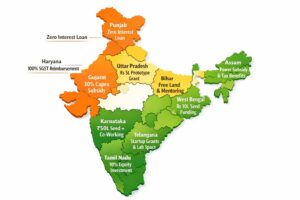
| State | Key Startup Benefits | Apply Via |
|---|---|---|
| Karnataka | ₹50 lakh seed funding, free co-working, patent support4–6% | startup.karnataka.gov.in |
| Maharashtra | ₹15 lakh grant, incubation, export support | msins.in |
| Kerala | ₹10 lakh grant, maker spaces, IPR support | startup.kerala.gov.in |
| Gujarat | 30% capex subsidy, GST reimbursement, land support | ic-startup.gujarat.gov.in |
| Telangana | T-Hub incubation, ₹25 lakh seed fund, global connects | t-hub.co |
| Rajasthan | iStart programme — incubation, ₹5 lakh grants | istart.rajasthan.gov.in |
| Tamil Nadu | StartupTN — seed fund, accelerator, market access/td> | startuptn.in |
| Delhi | Delhi Startup Policy — ₹15 lakh grant, co-working | startup.delhi.gov.in |
Every major Indian state runs its own startup scheme stack — often as valuable as central government schemes and far less competitive.
Action: Search “[Your State] startup policy 2026” and compare your state’s benefits against central schemes. In many cases, combining a central scheme (like SISFS) with a state scheme doubles your non-dilutive capital access.
Step-by-Step Application Guide: Top 3 Schemes {#how-to-apply}
How to Apply for DPIIT Recognition (15 minutes)
Documents needed:
- Incorporation certificate (from MCA21)
- PAN card of the company
- Brief description of your innovation (200 words)
- Director/Partner identification proof
Steps:
- Go to startupindia.gov.in → Click “Register”
- Create account using your business email
- Select “Get DPIIT Recognition”
- Fill company details: name, CIN, sector, founding date
- Write your innovation description — focus on what makes your product/process different
- Upload documents and submit
- Track status in your dashboard — approval in 2–4 weeks
How to Apply for SISFS Seed Fund (4–8 weeks process)
Documents needed:
- DPIIT Recognition Number (mandatory)
- Pitch deck (10–15 slides)
- 3-year financial projection model
- Founder CVs with relevant experience
- Product demo or prototype (video or live)
Steps:
- Visit startupindia.gov.in → “SISFS” → “Seed Fund Scheme”
- Browse approved incubators — filter by city and sector
- Shortlist 3–5 incubators whose portfolio matches your startup
- Submit application directly on the incubator’s website (each has its own form)
- Attend incubator interviews — expect 1–3 rounds
- If selected, sign incubation agreement and begin funding disbursement tied to milestones
- First tranche typically released within 30 days of agreement signing
How to Apply for CGSS Collateral-Free Loan (6–10 weeks process)
Documents needed:
- DPIIT Recognition Number
- Business plan (20–30 pages with financial projections)
- Last 2 years’ ITR (or since incorporation if less than 2 years)
- Audited financial statements
- Bank statements — 12 months
- Promoter KYC (Aadhaar, PAN, address proof)
Steps:
- Prepare a detailed business plan — this is where most applications fail (too thin)
- Approach 2–3 partner banks (SIDBI, SBI, HDFC, or listed CGSS partners)
- Submit your complete application — bank begins credit assessment
- Bank submits for CGSS guarantee — takes 2–4 weeks
- On CGSS approval, loan sanctioned and disbursed
- Repayment starts after agreed moratorium period (typically 6–12 months)
Which Scheme Is Right for Your Startup Stage? {#by-stage}
| Your Stage | Best Scheme | Why |
|---|---|---|
| Idea — no product yet | SISFS Grant (₹20L) | Equity-free, low barrier, prototype funding |
| Prototype — no revenue | SISFS Seed Fund (₹50L) + AIM Incubation | Capital + infrastructure + mentorship |
| Early revenue (<₹1Cr) | Mudra Tarun Plus (₹20L) + GeM Runway | Working capital + government revenue channel |
| Growth stage (₹1–10Cr) | CGSS (₹10Cr) + 80-IAC Tax Holiday | Scale capital + tax savings |
| Manufacturing/Hardware | PLI + CLCSS + CGTMSE | Production incentives + tech subsidy + credit |
| Deep Tech / AI / Space | Deep Tech Programme + IN-SPACe + FFS 2.0 | Dedicated 2026 track + patient capital |
| All stages | DPIIT Recognition | Gateway to everything above |
Common Mistakes That Get Applications Rejected {#mistakes}
These are the most frequent reasons government scheme applications fail — none of which competitors cover:
- KYC mismatch across documents A discrepancy between Aadhaar, GST, and ITR addresses triggers an automatic fraud flag in the 2026 DPIIT portal. Ensure all government documents show the same address before applying to anything.
- “Innovation” description is too vague Writing “We are building an innovative app” does not qualify. Your innovation description must specify: what existing problem you solve, why current solutions are inadequate, and what is technically or commercially novel about your approach.
- Applying for the wrong scheme stage SISFS is for startups less than 2 years old. CGSS is for established startups with a business plan. Applying to the wrong scheme wastes 2–3 months and creates a rejection record on your profile.
- Using the 80-IAC exemption in pre-revenue years Claiming the tax holiday when you have zero revenue wastes one of your three exempt years on a year with no tax liability anyway.
- Pure trading businesses applying for DPIIT DPIIT recognition requires genuine innovation. A business that buys and resells products without adding value will have recognition revoked. Do not apply unless your core activity involves developing an innovative product, service, or process.
- Not engaging with an incubator before SISFS application Cold applications to SISFS through incubators have low success rates. Visit the incubator, attend their events, and build a relationship before submitting your formal application. Warm applications from known founders have significantly higher acceptance rates.
What You Can Do This Week {#action}
Step 1 — Check if you are DPIIT-eligible today (30 minutes) Visit startupindia.gov.in and read the eligibility criteria. If your startup is less than 10 years old, has turnover below ₹100 crore, and involves any innovation — you almost certainly qualify. Begin the application this week.
Step 2 — Identify your stage-matched scheme from the table above Use the “Which Scheme Is Right for Your Stage” table to narrow down to 1–2 schemes. Focus your energy on the most relevant scheme rather than applying to everything at once.
Step 3 — Fix your KYC before applying to anything Ensure your Aadhaar, PAN, GST, ITR, and company registration all show consistent addresses and names. One mismatch rejects your entire application automatically.
Step 4 — Download the official scheme guidelines (free) Visit startupindia.gov.in/content/sih/en/government-schemes.html for the official, up-to-date documentation on every central government scheme. This is more current than any article, including this one.
Step 5 — Check your state’s startup policy Search “[Your State] startup scheme 2026” and compare state benefits alongside central schemes. Stacking a state scheme with SISFS can double your non-dilutive funding access without additional equity dilution.
Final Checklist Before You Apply {#checklist}
Before submitting any application, confirm you have:
Foundation documents:
- [ ] Company incorporated (Private Limited / LLP / Partnership)
- [ ] PAN registered for the company
- [ ] GST registration (if applicable to your business)
- [ ] Udyam MSME registration (for MSME-scheme access)
- [ ] DPIIT Recognition Number (for most central schemes)
- [ ] All documents showing consistent address and name (KYC mismatch = auto-rejection)
Application materials:
- [ ] Pitch deck (10–15 slides: problem, solution, market, traction, team, ask)
- [ ] Business plan (20–30 pages for CGSS; 5–10 pages for SISFS; 2–5 pages for Mudra)
- [ ] 3-year financial projections with revenue assumptions
- [ ] Founder CVs with relevant domain expertise highlighted
- [ ] Product demo / prototype / pilot evidence
Stage matching:
- [ ] Confirmed your startup is in the right stage for your chosen scheme
- [ ] SISFS: Less than 2 years old ✓
- [ ] 80-IAC: Applied in a profitable year, not a pre-revenue year ✓
- [ ] CGSS: Have a business plan demonstrating repayment capacity ✓
🔗 Related Articles on SevenFeeds
- Step-by-Step Startup India Registration Guide
- Top Indian Defence, AI & Space Startups to Watch in 2026
- Top Fintech Startups in India 2026
- Women-Led GenAI Startups in India 2025
- Best AI Tools for Startups 2026
External Authority Sources:
People Also Ask FAQs {#faqs}
The best government schemes for startups in India 2026 are: SISFS (up to ₹50 lakh equity-free), Fund of Funds 2.0 (₹10,000 crore corpus), CGSS (collateral-free loans up to ₹10 crore), Section 80-IAC tax holiday (3-year income tax exemption), and Mudra Tarun Plus (up to ₹20 lakh working capital). DPIIT recognition is the entry point to most of these.
Visit startupindia.gov.in, create an account, fill the recognition application with your business details and innovation description, upload your incorporation certificate and PAN, and submit. Approval typically takes 2–4 weeks. Your startup must be less than 10 years old, have turnover under ₹100 crore, and demonstrate an innovative product, service, or process.
SISFS provides up to ₹20 lakh as grants for proof of concept and prototype development, and up to ₹50 lakh as soft loans for market entry and commercialization — with zero equity dilution. Funding is disbursed through DPIIT-approved incubators. Apply via the Startup India portal.
Yes. Under Section 80-IAC, DPIIT-recognized startups can claim 100% income tax exemption for any 3 consecutive years within their first 10 years. The application window has been extended through March 31, 2030.
Budget 2026 announced an additional ₹10,000 crore FFS corpus managed by SIDBI, channeled through SEBI-registered AIFs into early-stage and deep-tech startups. Startups approach SIDBI-backed AIFs directly — not SIDBI itself.
Yes. CGSS provides collateral-free loans up to ₹10 crore with 80% credit guarantee for DPIIT-recognized startups. Mudra Tarun Plus provides up to ₹20 lakh for any micro/small business without DPIIT recognition.
On February 4, 2026, DPIIT formally recognized Deep Tech startups as a distinct category — covering AI, semiconductors, quantum computing, space tech, and advanced manufacturing. Deep Tech startups get longer recognition windows (proposed 15 years), access to dedicated Fund of Funds capital, and priority incubation support.
DPIIT-recognized startups register as sellers on gem.gov.in, list their products/services, and bid on government tenders through the Startup Runway feature. Government procurement from startups via GeM exceeded ₹2,000 crore in FY2025 — providing guaranteed, non-dilutive revenue.