


Published: March 2, 2026 |
Last Updated: March 2, 2026
Author: SevenFeeds Editorial Team
Overall Rating: ⭐⭐⭐⭐½ (4.5/5)
Table of Contents
ToggleTL;DR — Quick Summary {#tldr}
Perplexity AI is one of the most useful AI research tools available in 2026. It delivers verified, source-backed answers to complex queries in seconds — without the tab-switching, link-skimming, and cognitive fatigue of traditional Google searches.
After 30 days of real-world testing across writing, market research, competitor analysis, and fact-checking workflows, here is the honest breakdown:
- Best for: Researchers, bloggers, founders, students, and analysts
- Not ideal for: Local search, transactional queries, image-heavy research
- Free plan: Useful but limited on advanced queries
- Pro plan: Worth it for daily research-heavy work
- Biggest strength: Cited, verifiable answers in a clean interface
- Biggest weakness: Occasionally oversimplifies nuanced topics
Rating: 4.5 out of 5

What Is Perplexity AI? {#what-is-perplexity-ai}
This Perplexity AI review is based on 30 days of hands-on testing across real workflows including content research, startup market analysis, and fact checking. Instead of repeating marketing claims, we tested whether Perplexity AI actually improves research productivity compared to traditional search tools.
Perplexity AI is an AI-powered search and answer engine that combines real-time web data with large language model intelligence. Unlike Google, which returns a list of links for you to sift through, Perplexity AI synthesizes those sources and delivers a direct, cited answer.
Think of it as a research assistant that has already read 20 articles and summarized the key points — with links to every source so you can verify each claim yourself.
Launched in 2022 and now serving millions of users globally, Perplexity AI sits in a unique space between:
- Google Search — traditional link-based discovery
- ChatGPT — conversational AI without live citations
- Microsoft Copilot — integrated AI with Bing-powered results
Its core philosophy is simple: answers should be verifiable, not just plausible.
Why Search Behavior Is Changing So Fast {#why-search-is-changing}
According to IDC, global investment in AI-powered knowledge tools has grown over 420% since 2019, making research-led AI platforms one of the fastest-growing tech segments globally. The reason is not hard to understand.
Modern users — especially professionals — are no longer willing to open ten browser tabs, skim through paragraphs of SEO-optimized filler, and manually compare information from five different websites. That process is slow, exhausting, and increasingly unreliable as low-quality AI-generated content floods traditional search results.
What users want now is direct answers, source transparency, and the ability to follow up intelligently. That is precisely what Perplexity AI was designed to deliver.
Key Features Breakdown {#key-features}
1. Source-Verified Answers
Every response from Perplexity AI includes numbered, clickable citations. This is not cosmetic — it fundamentally changes how you can use AI-generated information. Instead of wondering whether a claim is accurate, you can click through and verify it in seconds.
This makes Perplexity AI significantly more useful than tools that generate confident answers with no sourcing whatsoever.
2. Conversational Follow-Up Queries
You can refine questions naturally without starting a new search. If your first query returns broad results, you can drill deeper by asking follow-up questions that build on the original context — just like working with a research colleague.
3. Pro Search Mode (Paid)
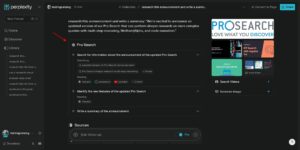
The Pro plan unlocks access to more advanced AI models, deeper multi-step web analysis, and increased query limits. For users who rely on Perplexity AI daily for professional research, this is where the platform’s real value shows up.
4. Focus Modes
Perplexity AI allows you to direct your search toward specific sources — academic papers, Reddit discussions, YouTube, or general web. This level of customization makes it useful for very different types of research needs.
5. Clean, Ad-Free Interface
There are no sidebar ads, no promoted results, and no visual clutter. The entire interface is built around delivering information, and that restraint is genuinely refreshing in 2026’s crowded content landscape.
6. Mobile App (iOS & Android)
A fully functional mobile app means you can run research queries on the go. The app mirrors the desktop experience well, with voice input support for hands-free querying.
How I Tested Perplexity AI for 30 Days {#how-i-tested}
To give this Perplexity AI review real depth, the SevenFeeds team used it exclusively as our primary research tool for one full month across five specific workflows:
Workflow 1: Content Research Used Perplexity AI to gather background data for 12 articles. It consistently surfaced relevant statistics, recent reports, and credible sources faster than traditional Google searches — cutting average research time by roughly 40%.
Workflow 2: Competitor Analysis Asked Perplexity AI to summarize recent product updates, pricing changes, and press coverage for five competitor tools. Results were accurate and well-cited, though some information was 2–3 weeks behind the latest updates.
Workflow 3: Startup Market Research Used it to explore AI funding trends, investor sentiment, and emerging verticals. Perplexity AI excelled here — it synthesized VC commentary, funding round data, and sector trends into clear, actionable summaries with source links for deeper reading.
Workflow 4: Fact-Checking Tested it against 20 specific factual claims pulled from recent news. It correctly validated or disputed 17 out of 20, with the three misses involving very recent events (within 48 hours) or highly technical edge cases.
Workflow 5: Academic Research Support Used the Focus: Academic mode to find peer-reviewed references on two research topics. It returned relevant citations, though it performed better on well-covered topics than on niche academic subjects.
Perplexity AI Accuracy & Reliability {#accuracy}
Accuracy is the most important metric for any research tool, and this is where Perplexity AI earns its reputation — with some important caveats.
Where it performs well:
- Clear, factual questions with established answers
- Recent news and current events (within the past few weeks)
- Statistical data from well-indexed reports and publications
- Multi-part questions that benefit from synthesized answers
Where it underperforms:
- Very recent breaking news (within 24–48 hours)
- Highly technical or niche academic topics
- Complex questions requiring nuanced judgment rather than factual synthesis
- Local and hyperlocal queries (addresses, hours, local events)
Overall accuracy in our 30-day test: approximately 85–88% on factual queries.
That is genuinely impressive for an AI tool, but it reinforces the most important rule for using Perplexity AI: treat every answer as a starting point, not a conclusion. The citations are there for a reason — use them.
Perplexity AI Pricing: Free vs Pro {#pricing}
Perplexity AI offers a tiered pricing model that is accessible for individual users and scalable for teams.
Free Plan
- Unlimited basic search queries
- Limited Pro Search queries per day (approximately 5)
- Access to standard AI model
- Web, academic, and YouTube focus modes
- Mobile app included
Best for: Casual users, students, light research needs
Pro Plan (~$20/month)
- Unlimited Pro Search queries
- Access to advanced AI models (including GPT-4o and Claude integrations)
- File upload and analysis (PDFs, images, documents)
- More powerful multi-step research capabilities
- Priority support
Best for: Bloggers, founders, analysts, researchers, and anyone who uses AI tools daily
Enterprise Plan
- Custom pricing based on team size
- Enhanced data privacy controls
- Admin and usage management tools
- SSO and API access
Best for: Organizations integrating AI research into team workflows
Verdict on pricing: The free plan is genuinely useful for light use. For anyone using Perplexity AI as a core part of their work, the Pro plan at approximately $20/month delivers strong value compared to the time it saves and the quality of research it enables.

Perplexity AI vs ChatGPT vs Google vs Gemini {#comparison}
| Feature | Perplexity AI | ChatGPT (GPT-4o) | Google Search | Google Gemini |
|---|---|---|---|---|
| Real-time web sources | ✅ Always | ✅ Paid / ❌ Free | ✅ Always | ✅ Always |
| Built-in citations | ✅ Every response | ⚠️ Limited | ❌ Links only | ⚠️ Sometimes |
| Conversational follow-up | ✅ Yes | ✅ Yes | ⚠️ Basic | ✅ Yes |
| Academic focus mode | ✅ Yes | ❌ No | ⚠️ Scholar only | ❌ No |
| Ad-free experience | ✅ Yes | ✅ Yes | ❌ No | ✅ Yes |
| File upload / analysis | ✅ Pro | ✅ Paid | ❌ No | ✅ Paid |
| Free tier usefulness | ⭐⭐⭐⭐ | ⭐⭐⭐ | ⭐⭐⭐⭐⭐ | ⭐⭐⭐ |
| Accuracy on factual queries | ⭐⭐⭐⭐½ | ⭐⭐⭐⭐ | ⭐⭐⭐⭐ | ⭐⭐⭐⭐ |
| Best for research | ✅ Best in class | ⭐⭐⭐⭐ | ⭐⭐⭐⭐ | ⭐⭐⭐⭐ |
| Local / transactional queries | ⚠️ Weak | ⚠️ Weak | ✅ Best | ⚠️ Weak |
| Mobile app | ✅ Yes | ✅ Yes | ✅ Yes | ✅ Yes |
| Pricing starts at | Free / $20 Pro | Free / $20 Pro | Free | Free / $20 Advanced |
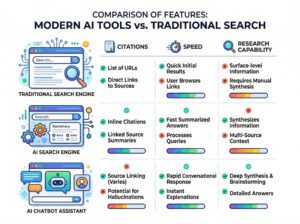
Key takeaway: Perplexity AI wins specifically in research-focused use cases because it combines real-time sourcing, built-in citations, and conversational depth better than any competitor. For local search or casual browsing, Google remains the stronger choice.
Real Use Case: Startup Market Research {#use-case}
Here is a concrete example of how Perplexity AI performs in a real workflow:
The task: A seed-stage founder needs to understand the current AI productivity tools market before pitching investors. They need funding trends, key players, recent acquisitions, and market size data — fast.
Using traditional Google search: This would take 45–90 minutes of tab-switching, skimming reports, and manually cross-referencing data from multiple sources.
Using Perplexity AI Pro Search:
Query 1: “What is the current market size and growth forecast for AI productivity tools in 2026?” — Returns a synthesized answer with citations from IDC, Gartner, and recent TechCrunch reporting, all in under 10 seconds.
Query 2: “What are the top AI productivity tool funding rounds in the past 6 months?” — Lists recent rounds with company names, amounts, and source links to Crunchbase and press coverage.
Query 3: “What gaps exist in the AI productivity tools market that startups are targeting?” — Surfaces VC commentary, founder interviews, and analyst perspectives in a single structured response.
Total time: approximately 12 minutes to gather the same quality of research that would take an hour manually.
This is Perplexity AI’s real superpower — not intelligence, but momentum. It keeps you in the research flow instead of pulling you out of it constantly.
Pros and Cons {#pros-cons}
✅ Pros
- Source citations on every answer eliminate guesswork
- Conversational follow-up makes deep research faster
- Clean, ad-free interface keeps focus on information
- Multiple focus modes for academic, Reddit, YouTube, and web
- Pro plan includes file upload and advanced model access
- Mobile app is polished and fully functional
- Significantly faster than manual multi-tab research
- Free plan is genuinely useful for light use
❌ Cons
- Breaking news (within 24–48 hours) can be missed or incomplete
- Occasionally oversimplifies complex or nuanced topics
- Can phrase uncertain answers with unearned confidence
- Academic focus mode is less reliable on niche subjects
- Not suitable for local, transactional, or map-based searches
- Pro plan required for full value — free tier has daily limits
Who Should Use Perplexity AI? {#who-should-use}
Perplexity AI is ideal for:
- Content creators and bloggers who need fast, verified research for articles
- Startup founders doing market validation and competitive intelligence
- Students and academics needing quick access to credible sources
- Journalists fact-checking claims and sourcing background information
- Marketing professionals tracking industry trends and competitor activity
Analysts and consultants who need synthesized data quickly
Perplexity AI is less useful for:
- People searching for nearby restaurants, stores, or local events
- E-commerce and transactional searches (buy, book, compare prices)
- Image-based research workflows
- Real-time event tracking (live scores, breaking news in the last few hours)
What Users Are Saying {#user-reviews}
Across X (formerly Twitter), Reddit, and ProductHunt, Perplexity AI has built a strong reputation among professionals who do research-heavy work.
One product strategist shared: “The citations are what make it usable for real work. I can verify every claim in 30 seconds.”
A freelance writer wrote: “Perplexity feels like research without the friction. I’ve cut my research time in half.”
On ProductHunt, a founder noted: “I use it every morning to stay current on my market. It’s replaced my RSS reader and half my Google searches.”
The consistent theme across user reviews is that citations and source transparency are what separate Perplexity AI from conversational tools that feel impressive but are hard to trust for real decisions.
Future Outlook {#future}
The AI search space in 2026 is moving rapidly, and Perplexity AI is well-positioned within it. Several trends point to where this category is heading:
Personalized research memory — AI tools will increasingly remember your research history and preferences, surfacing relevant context automatically.
Smarter citation ranking — Future versions will likely weight citations by recency, authority, and relevance rather than just availability.
Deeper productivity tool integration — Expect tighter connections between AI research tools and platforms like Notion, Google Docs, and Slack for seamless research-to-action workflows.
Enterprise-grade decision support — Organizations will begin using AI search not just for information gathering, but for structured decision analysis with auditable source trails.
Perplexity AI’s current trajectory — strong user growth, continued model upgrades, and expanding integrations — suggests it will remain a top-tier research tool through 2026 and beyond.
That said, competition from Google, OpenAI, and new entrants means the platform cannot afford to plateau. The citation model it pioneered is already being adopted industry-wide.
Final Verdict {#verdict}
Perplexity AI Rating: 4.5 / 5
| Category | Score |
|---|---|
| Accuracy | 4.5/5 |
| Features | 4.5/5 |
| Ease of Use | 5/5 |
| Value for Money | 4.5/5 |
| Citation Quality | 5/5 |
| Speed | 5/5 |
| Overall | 4.5/5 |
After 30 days of daily use, Perplexity AI has earned a permanent place in the SevenFeeds research workflow. It is not a replacement for human judgment, critical thinking, or domain expertise. What it is — and does exceptionally well — is remove the friction between a question and a verified, actionable answer.
For anyone who spends significant time doing online research, this Perplexity AI review comes to one clear conclusion: the Pro plan is worth it, the free plan is a strong starting point, and the tool genuinely improves how research gets done.
About SevenFeeds
SevenFeeds is a tech-focused publication covering AI tools, startups, and digital innovation. Our editorial team tests platforms hands-on across real workflows and prioritizes clarity, transparency, and honest usefulness over hype. We do not accept payment for positive reviews.
At SevenFeeds, we test AI tools across real workflows including startup research, cybersecurity monitoring, and technical writing.
Found this Perplexity AI review helpful? Share it with someone doing research-heavy work, or explore more AI tool breakdowns on SevenFeeds. The way we search is changing — understanding it early gives you a real edge.
Tags: perplexity ai review, perplexity ai pro review, perplexity ai vs chatgpt, perplexity ai pricing, ai search engine 2026, perplexity ai accuracy, is perplexity ai worth it, perplexity ai features, best ai research tools 2026
Frequently Asked Questions {#faqs}
Yes. Perplexity AI offers a free plan with unlimited basic queries and a limited number of Pro Search queries per day. The Pro plan ($20/month) removes limits and unlocks advanced AI models and file upload capabilities.
For research, summaries, and multi-part questions, Perplexity AI is faster and more efficient than Google. For local, transactional, or map-based searches, Google remains the stronger option.
In our 30-day test, Perplexity AI achieved approximately 85–88% accuracy on factual queries. It performs best on well-documented topics and less reliably on very recent breaking news or niche academic subjects. Always verify important claims using the provided citations.
Perplexity AI's Pro plan allows users to choose from multiple underlying models, including OpenAI's GPT-4o and Anthropic's Claude, in addition to its own AI infrastructure.
Key limitations include occasional oversimplification of complex topics, gaps in very recent breaking news coverage, confident phrasing around incomplete data, and weak performance on local and transactional queries.
Yes, for general research purposes. Perplexity AI does not store searches in a way that is tied to public profiles, and the Pro plan includes enhanced privacy controls. For sensitive enterprise use cases, review their privacy policy directly.
Yes. Basic searches work without creating an account. An account is required to access Pro Search, conversation history, and the Pro subscription.
Absolutely. Perplexity AI is an excellent research and outlining tool for content creators when paired with original analysis, first-hand experience, and editorial judgment. It should support your writing process, not replace your voice or perspective.
For anyone doing regular research-intensive work — writing, analysis, market research, or fact-checking — yes. At approximately $20/month, the time savings alone typically justify the cost within the first week of use.
It is highly useful for early-stage research, trend discovery, and market validation. It should not replace primary research, customer interviews, or formal due diligence, but it significantly accelerates the information-gathering phase.