The OpenAI AI video app creates 100% AI-generated short videos using Sora 2.
No human uploads allowed — every clip is born from prompts.
Face verification + likeness alerts aim to protect users, but raise privacy debates.
Early testers found it “addictive,” though risks around copyright, moderation, and disinformation remain.
With TikTok under pressure, this may become the first global AI-only video platform.
Introduction: The Future of Feeds Is Synthetic
What happens when TikTok’s endless scroll meets AI’s generative power? The answer might be the OpenAI AI video app, a bold experiment where every clip is AI-made.
Instead of user uploads, OpenAI bets on synthetic media as the default, challenging how we define creativity, authenticity, and even trust online.
👉 Imagine opening the app tomorrow: every smiling face, every viral dance, every news update — none filmed, all generated. Would you still scroll?
Key Features & Design Choices
🎥 All-Generated Content
Unlike TikTok or Instagram, the OpenAI AI video app allows zero human uploads. Everything is generated inside the platform using Sora 2 (Wired).
🛡️ Face Verification + Consent Alerts
To tackle deepfake risks, users verify their face. If anyone tries to use that likeness, alerts are triggered. A strong step, but it also sparks questions: where is this biometric data stored?
📊 Early Internal Tests
Reports from testers show high engagement — addictive, even. But moderation at scale could drain resources and invite backlash.
⚖️ Copyright & Legal Headwinds
OpenAI is already facing lawsuits over training data. Critics warn that the AI-only content pipeline may intensify legal and ethical scrutiny (Times of India).
Why This Matters
For Creators
Pro: No production costs — anyone can generate content.
Con: Ownership confusion — who owns an AI-made video?
For Platforms
Lower reliance on human creators.
Higher reliance on moderation + watermarking tools.
For Regulators
Consent alerts are good, but what about minors?
How will misinformation be detected and flagged?
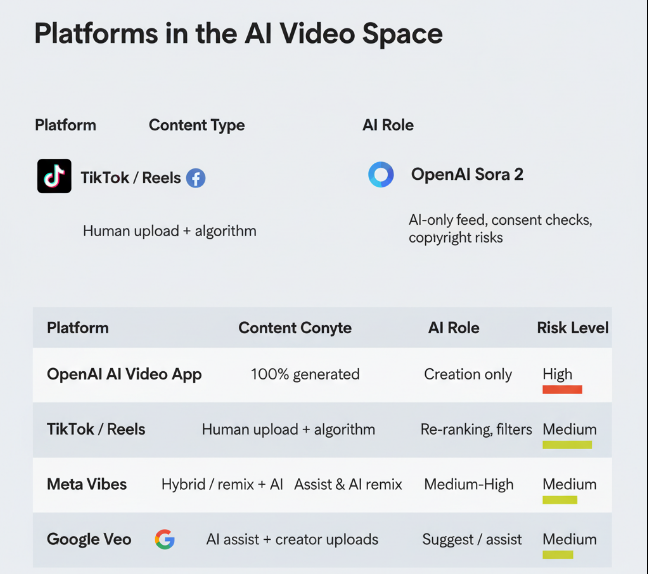
Comparison: Platforms in the AI Video Space
Platform
Content Type
AI Role
Risk Level
OpenAI AI Video App
100% generated
Creation only
High (copyright, misuse)
TikTok / Reels
Human upload + algorithm
Re-ranking, filters
Medium
Meta Vibes
Hybrid / remix + AI
Assist & AI remix
Medium-High
Google Veo
AI assist + creator uploads
Suggest / assist
Medium
Practical Use Cases
Newsrooms: AI-generated news shorts with citations.
Finance: Filing summaries turned into 15-sec explainers.
Education: Micro-lessons in AI-generated video form.
Enterprise: Training modules via AI avatars.
Gaps & Challenges
❓ Biometric privacy (who controls face data?).
❓ Monetization model (ads, subs, revenue split?).
❓ Copyright provenance.
❓ Global regulation (EU AI Act, US FTC scrutiny).
Future Outlook 🚀
In the next 12–18 months, expect:
Watermarked AI content becoming standard.
Partnerships with publishers for training rights.
Monetization models for creators of AI prompts.
Global policy debates around synthetic media.
👉 Don’t wait for regulation to catch up — explore now. Whether you’re a startup founder or a content creator, this shift will reshape attention economies.