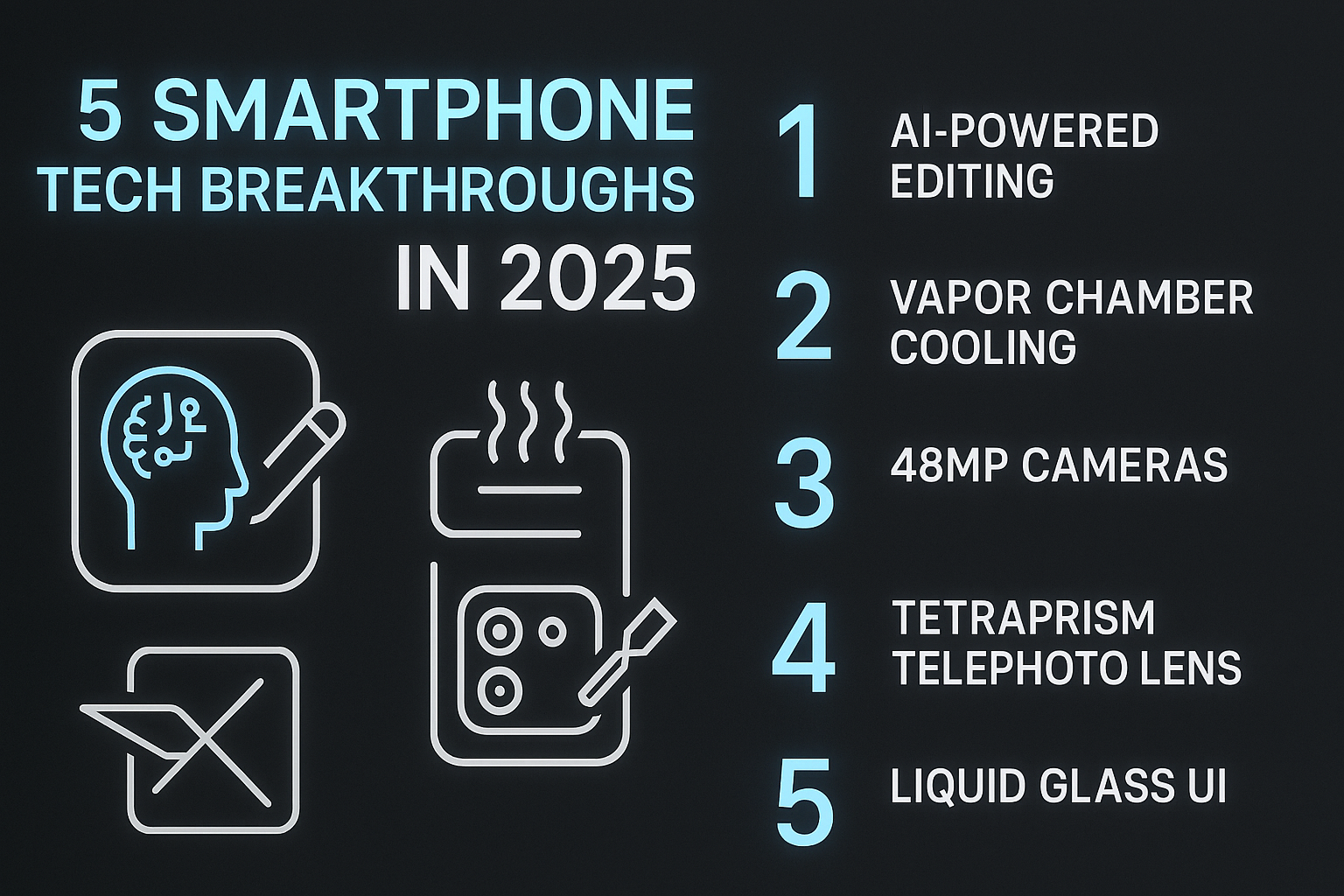
AI-powered photo editing on phones will disrupt creative apps.
Vapor chamber cooling smartphones open new ground for mobile gaming.
48MP smartphone camera innovations redefine mobile photography.
Next-gen phone AI chip brings private, local AI.
Liquid Glass UI design makes interaction immersive.
📱 Smartphones Are About to Change Again
When was the last time your phone truly surprised you? Back in 2020, triple cameras felt futuristic. Fast-forward to 2025, and Apple’s iPhone 17 Pro Max technology is setting the tone for a new smartphone era — one where your phone acts like a studio, gaming console, and AI assistant in your pocket.
In this article, we’ll break down the 5 smartphone tech breakthroughs of 2025 — from AI photo editing to liquid glass UIs — and why they matter for founders, creators, and early adopters.
🔮 1. AI-Powered Photo Editing on Phones
Gone are the days when editing apps were optional. In 2025, AI photo editing is built directly into smartphones, letting you remove photobombers, fix lighting, or even re-style photos in seconds.
Apple iPhone 17 Pro Max leverages its A19 Pro chip for real-time photo adjustments.
Google Pixel 10 Pro integrates Gemini Nano AI for instant edits.
Samsung Galaxy S25 Ultra pushes ML pipelines for advanced HDR.
📊 Stat: IDC estimates that by 2025, over 72% of smartphone users will use AI editing tools weekly — up from just 28% in 2022.
📌 Example: The iPhone 17 Pro Max enables instant 48MP photo corrections, making manual editing almost obsolete.
👉 Founder Insight: If you’re building creative apps, explore APIs for AI-powered editing. User demand for “one-tap fixes” is exploding.
⚡ 2. Vapor Chamber Cooling in Smartphones
Remember when gaming on your phone made it overheat within minutes? By 2025, vapor chamber cooling smartphones are the new norm.
Apple’s iPhone 17 Pro Max thermal redesign enables all-day gaming.
Gaming phones like ASUS ROG already use liquid cooling — but mainstream adoption means it’s here to stay.
AR and VR headsets are next in line for thermal breakthroughs.
📌 Example: ASUS ROG phones already use liquid cooling, but the iPhone 17 Pro Max’s thermal redesign signals mainstream adoption.
📊 Data Point: Tests show vapor chambers reduce heat throttling by up to 40% compared to traditional graphite cooling.
🔥 Founder Insight: For mobile-first startups, device cooling directly impacts UX. A faster chip is worthless if your app throttles.
📸3. 48MP Smartphone Camera Innovations
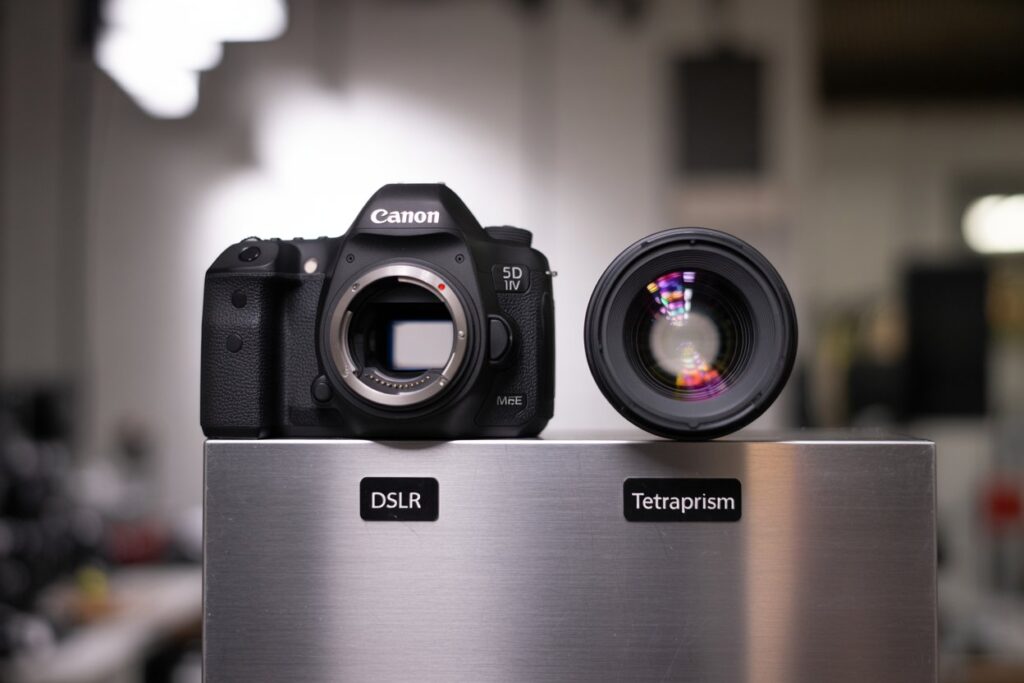
2025 is the year 48MP cameras become a storytelling standard. It’s not just megapixels — it’s about smarter HDR, larger sensors, and Apple’s tetraprism telephoto lens.
Apple’s zoom system rivals DSLR optical performance.
Xiaomi and Vivo push periscope lenses for ultra-zoom clarity.
Computational photography startups are rethinking what a “camera” means.
📊 Trend: Over 35% of indie filmmakers now use flagship phones as secondary cameras, citing RAW capture and AI color grading.
👉 Founder’s Take: For creative startups, customers now expect studio-level output from a pocket device.
🧠 4. AI Chips Meet Next-Gen Connectivity: The Snapdragon X80 Effect
📊 Fact: Qualcomm reports the Snapdragon X80 can boost network efficiency by 20%, enabling smoother AR/VR experiences.
🚀 Founder Insight: Build apps that work offline-first with AI chips, then sync seamlessly — this is the new UX standard.
🎨 5. Liquid Glass UI Design
Flat UIs are dead. Enter Liquid Glass UI — immersive, dynamic, adaptive.
iPhone 17 Pro Max: shows UI scaling and motion depth.
Android OEMs: experimenting with 3D glass effects.
UX Designers: finally get tools beyond color themes.
📌 Checklist for Founders: ✔ Motion design = app identity ✔ Test across budget + flagship devices ✔ Prepare for cross-device UI shifts (phone → AR → wearables)
📊 Quick Comparison Table: Old vs New
Feature
2023 Smartphones
2025 Smartphones
Photo Editing
Manual/Filters
AI-Powered Editing
Cooling
12–24MP, limited zoom
Vapor Chamber Cooling
Camera Tech
Soft metrics
48MP + Tetraprism Zoom
AI Processing
Cloud-Dependent
On-Device AI Chips
User Interface
Flat Glass UI
Liquid Glass Design
🌟 Why This Matters for Startups & Founders
Smartphones aren’t just consumer gadgets — they’re platforms for business innovation:
Developers: Can now build apps directly leveraging AI chips.
Content Creators: Have studio-level tools in their pocket.
Gaming Startups: Benefit from cooler, high-performance devices.
UI/UX Designers: Can experiment with immersive, motion-first design.
📌 Conclusion: The Smartphone = Studio + AI Hub
Smartphones in 2025 aren’t just communication devices — they’re studios, gaming consoles, and AI copilots. Inspired by iPhone 17 Pro Max technology, these breakthroughs will reshape how we create, work, and play.
👉 If you’re a founder, developer, or tech enthusiast, align your next idea with these mobile shifts. The winners of 2025 will be those who design for AI-first devices.
💬 Your Turn: Which breakthrough excites you most — AI photo editing, vapor chamber cooling, or liquid glass UIs? Drop your thoughts in the comments!
📌 FAQs on Smartphone Tech Breakthroughs in 2025
AI editing, vapor chamber cooling, 48MP tetraprism cameras, AI-driven chips, and liquid glass UIs.
.
It spreads heat evenly, ensuring smoother performance and battery efficiency during gaming or heavy use.
For casual users, yes. For professionals, DSLRs still matter, but smartphones now rival them in everyday use.
AI powers editing, personalization, offline processing, and AR — reducing reliance on the cloud.
They unlock new opportunities for AI-driven apps, pro-level content creation, and immersive user experiences.
👤 Author Bio
Written by Sevenfeeds — covering the intersection of tech, startups, and AI. Explore more deep dives at sevenfeeds.com.
Thank you for your sharing. I am worried that I lack creative ideas. It is your article that makes me full of hope. Thank you. But, I have a question, can you help me? https://www.binance.com/sk/register?ref=WKAGBF7Y








Your point of view caught my eye and was very interesting. Thanks. I have a question for you.
Your article helped me a lot, is there any more related content? Thanks! https://accounts.binance.info/sk/register-person?ref=WKAGBF7Y
Your article helped me a lot, is there any more related content? Thanks!
Can you be more specific about the content of your article? After reading it, I still have some doubts. Hope you can help me. https://accounts.binance.com/en-NG/register-person?ref=YY80CKRN
Your article helped me a lot, is there any more related content? Thanks!
Thank you for your sharing. I am worried that I lack creative ideas. It is your article that makes me full of hope. Thank you. But, I have a question, can you help me? https://www.binance.com/sk/register?ref=WKAGBF7Y