Over 90 percent of Indian startups fail before year five, and most collapse because the market never wanted what they built.
The smartest founders validate before building using surveys, landing pages, WhatsApp responses, or small MVPs.
India is a high-diversity market, so early interviews and segment mapping matter more than assumptions.
Case studies like Sugar Cosmetics, Zepto, and BharatAgri show how early micro-testing leads to product-market fit.
Your goal is simple: Prove real people will pay (or show buying intent) before you spend serious time and money.
Why Learning How to Validate Your Startup Idea Matters in India
According to the Department for Promotion of Industry and Internal Trade (DPIIT), India crossed 117,000 registered startups, making it one of the fastest-growing ecosystems in the world. Yet most first-time founders still make the same mistake:
They build before validating, instead of validating before building.
India’s consumer behavior is unpredictable, segmented, price-sensitive, and influenced heavily by:
Region
Language
Social status
Lifestyle
Digital exposure
This means an idea that feels perfect in Bengaluru may never work in Ranchi, and something that fails in Delhi may thrive in Guwahati.
So the real question is:
Can you prove that strangers — not friends, not family — will pay for your product?
This article breaks down a real, practical playbook on how to validate your startup idea in India without burning money.
A Real Tweet That Explains the Whole Problem
“Startups rarely die from starvation. They die from indigestion.” — @IndusVC
In other words: Most startups fail because they do too much, too early, without validating whether the market cares.
Step 1: Write Down Your Assumptions (So You Can Test Them)
Every startup idea rests on assumptions:
Who is the customer?
What problem are they facing?
How are they solving it today?
Why will they switch to you?
Will they pay, and how much?
Don’t guess — write them down. The Lean Startup method calls this a hypothesis board, and almost every great founder does it before investing in development.
Example (simple):
Assumption
How to Test
Parents in tier-2 cities struggle to find high-quality tutors
WhatsApp surveys with 30 parents
They are willing to pay for online learning
Ask for pre-payment or deposit
They prefer bilingual tutors
Interview until patterns emerge
If your assumptions are wrong, that’s good. Better to discover it now, not after building a full product.
Step 2: Talk to 30–50 Real Target Users
In the Indian market, talking to users early gives unfair advantage. Great founders obsess over this.
A startup veteran once told me after reviewing a founder’s pitch:
“You have a product roadmap, but no insights from real users. That’s not a startup. That’s a school assignment.”
How to do user interviews well
Ask about:
Their current habits
How they solve the problem today
What frustrations they face
What they spend on the problem today
What would make them switch
Avoid pitching. Your goal is to listen, not sell.
Quick ways to find interview participants in India
LinkedIn groups
Facebook groups
College alumni networks
WhatsApp communities
Reddit India subgroups
Local startup meetups
Instagram polls
If people refuse to talk, that itself is data. It means the problem isn’t urgent for them.
Step 3: Send a Short Customer Survey (But Keep It Focused)
If you want volume, surveys help — especially when:
Your audience is large
Segments are unclear
Preferences vary widely
But don’t send a 30-question Google Form. People in India won’t finish it.
Ask 8–10 laser-focused questions:
What problem do you face today?
What solutions have you tried?
How much do you spend currently?
Hardest part of the process?
Would you pay for a solution?
How much?
If yes, drop your WhatsApp number or email.
If they leave contact details, they feel real pain — that’s a strong validation signal.
Step 4: Build a Simple MVP (Not a Big-App Launch)
An MVP in India doesn’t have to be an app. Some of the biggest consumer startups began with extremely small experiments.
Examples
Zepto started with a simple WhatsApp ordering workflow before building their full stack.
Ola began with bookings via phone.
Urban Company launched with a basic website and manually assigned service providers.
An MVP can be:
Google Form
WhatsApp automation
Email workflow
Landing page
Clickable UI prototype
Figma mockup
No-code app
Limited offer website using Canva + Notion
Some founders even validate payments using:
Razorpay payment link
Instamojo
Paytm QR
UPI
If people pay — even a small amount — that validates demand more strongly than any survey.
Step 5: Use a Landing Page with Measurement
A simple landing page can tell you everything:
How many people visit
How many show interest
How many leave details
What messaging performs better
Tools like:
Carrd
Framer
Notion website
Webflow
Wix
…let you build a landing page in under two hours.
Add:
One clean headline
A description of your value
Social proof (if possible)
A CTA:
“Join the waitlist” “Book a demo” “Request trial” “Pay to pre-order”
Then run small traffic tests:
₹300–₹800 Instagram Reel boost
LinkedIn post
Founder networking groups
Reddit AMAs
Startup forums
Twitter/X
If your landing page gets:
5–10% signup rate — solid interest
20%+ — extremely strong signal
Step 6: Measure Real Engagement (Not Vanity Metrics)
Indian founders sometimes make this mistake:
200 people liked the post.
So the idea must be good.
Likes aren’t validation. Action is validation.
Look for signals like:
Pre-payments
Deposits
Email sign-ups
Repeat usage
Referrals
Requests for features
People willing to switch providers
As one accelerator mentor told me:
“The day users chase you, instead of you chasing users, you’ve found early product-market fit.”
Case Studies: Indian Startups That Validated Smart
1. Sugar Cosmetics
When Sugar launched, they didn’t open big showrooms or mass-market campaigns. They tested demand through:
Small retail shelves
Fast iteration cycles
Real-time feedback loops
Today, the company has raised capital, expanded retail, and built a massive Gen-Z-driven brand.
2. BharatAgri
Before building full agritech automation, the founders visited farms, spoke with farmers, and validated crop-specific needs. Their understanding came from months of field interviews, not assumptions.
3. Zepto
Before becoming a unicorn, they validated hyper-demand with:
A WhatsApp order system
Manual deliveries
Early delivery promise experiments
Only after proving usage did they build logistics and apps.
These are not exceptions — these are patterns. Indian startup winners validate first, build later.
This is why validation is not optional — it’s survival.
How to Validate Your Startup Idea: A Simple Checklist
✔ Customer interviews
Target: 30–50 people
✔ Surveys
6–10 key questions
✔ Market size research
Use:
DPIIT data
Statista
Local industry reports
Press articles
✔ MVP
Small + fast + testable
✔ Landing page
Includes sign-up or pre-order
✔ Measurable metrics
Actions > likes
Personal Insight
I’ve seen startups with:
Beautiful apps
Polished decks
Strong teams
…shut down within 12 months because they never validated whether people would pay.
I’ve also seen founders who:
Built a product in Notion
Ran WhatsApp groups
Collected UPI payments manually
…reach their first 500 paying users without writing a single line of code.
In India, speed is not about building fast. Speed is about learning fast.
Future Outlook
Over the next three to five years:
Automated validation tools (AI user interviews, heatmaps, feedback synthesis) will become standard.
Early payment proofs will become a requirement for accelerators.
Founders with validation discipline will raise faster and burn less.
Indian customers will expect personalized products from day one.
Meaning:
The competitive edge in India will belong to founders who validate faster than others can build.
Planning to launch a startup this year?
Comment or message “Validation Kit” and I’ll send:
Survey template
12 best interview questions
MVP examples for different industries
A simple Google Sheet tracking model
Make your launch data-driven, not guess-driven.
Who We Are
SevenFeeds is a platform that turns market trends into actionable frameworks for founders, MSMEs, and solo entrepreneurs. We analyze what works in the real world and convert it into easy, stepwise playbooks.
Our mission: Help small brands grow smarter, not harder.
FAQs: How to Validate Your Startup Idea
Talk to potential users, build a small MVP, and check if they’re willing to pay or switch immediately.
30–50 interviews are usually enough to notice repeating patterns and real needs.
Not always. Many Indian startups validated through WhatsApp, Google Forms, or simple landing pages.
2–6 weeks is enough for most consumer and B2B ideas.
Validation proves real interest. Product-market fit proves repeat usage, referrals, and organic pull.
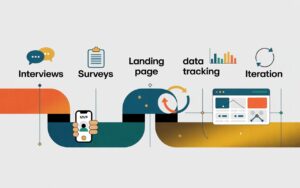
That means the pain isn’t strong enough yet. Payment or clear buying intent is the only real validation.Clean startup-style infographic showing 6 steps (interviews, surveys, MVP, landing page, data tracking, iteration), modern flat design, Indian startup theme
Yes — it saves time, money, and helps build something people genuinely need.